Hey, we are an collective of activists based in Dresden, Germany who currently are planning a solidarity trip to Ukraine. The main reasons for this are humanitarian aid, solidarity work, and networking. The trip will be from September 29 to October 11, 2026. Throughout the trip we will be visiting various self-organized collectives and organizations who help people on site.
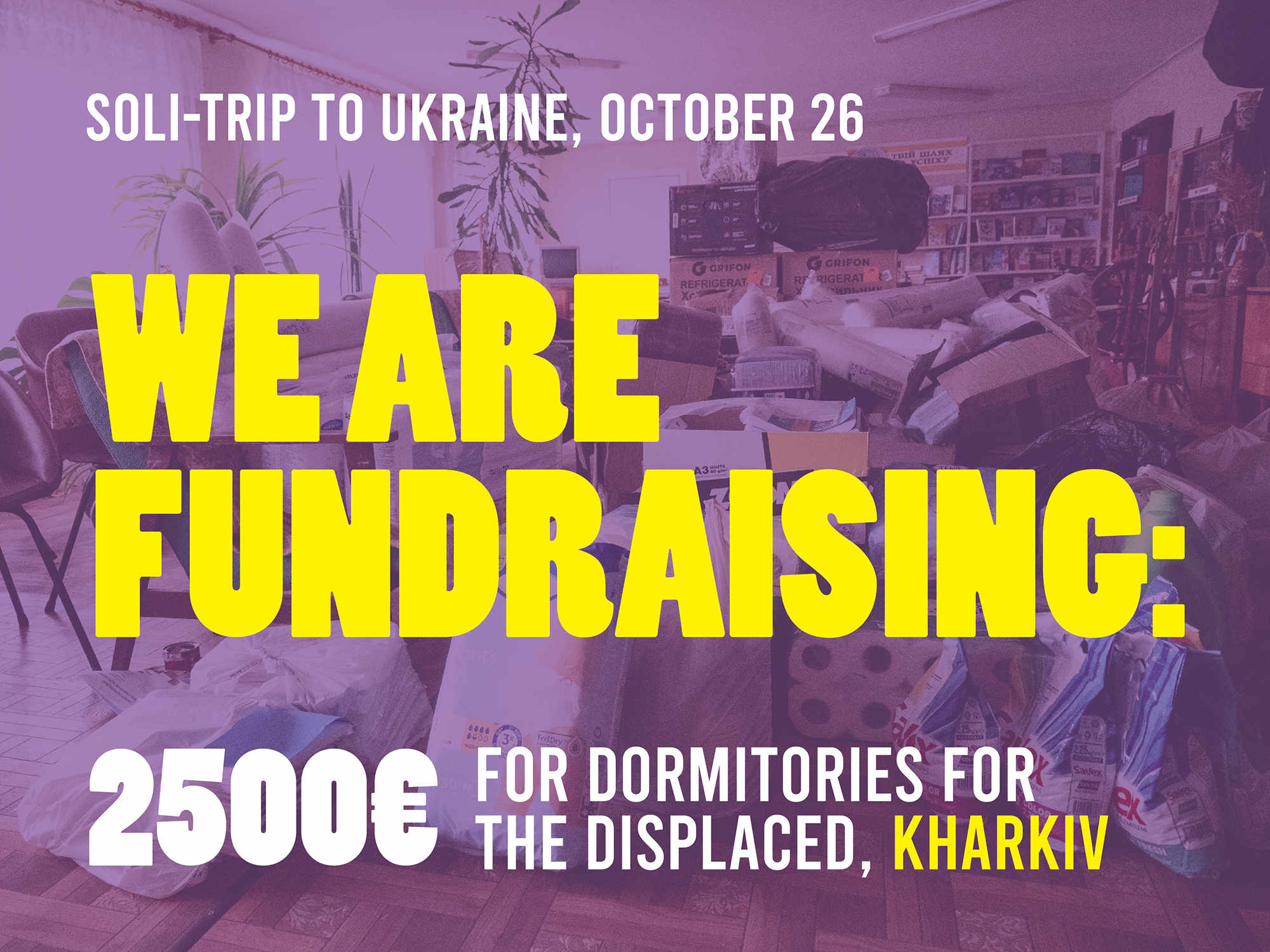
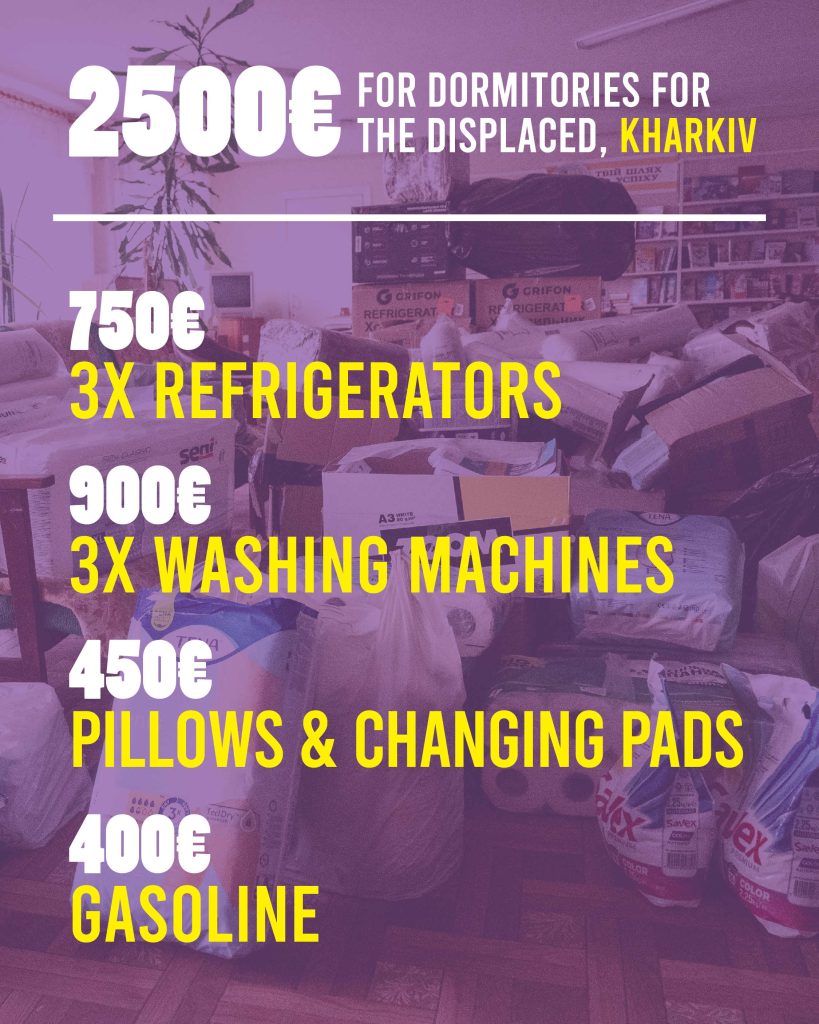
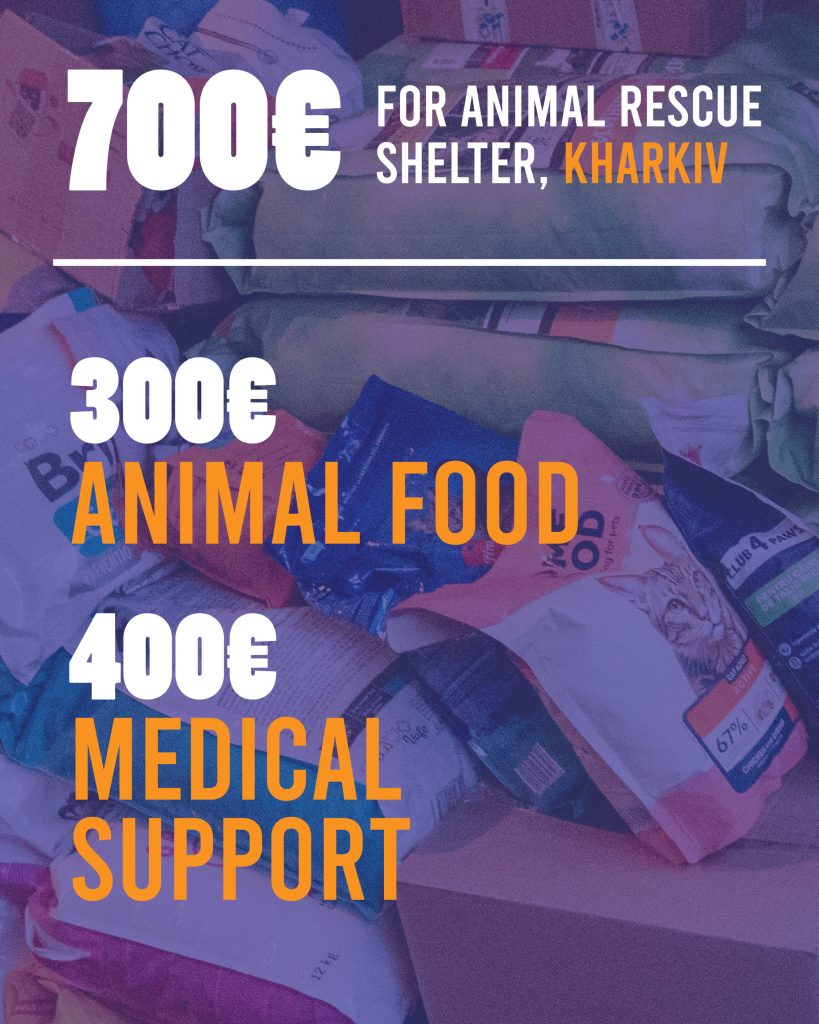
On this trip we will be visiting various collectives and organizations. Among them are Street Aid Daily (SAD) in Odessa and Solidarity Collectives. They are – among other things – doing supporting work for anti-authoritarian fighters at the front and homeless people, mutual aid, and community building. We will travel together to Kharkiv to meet with people who have been displaced by the war and bring humanitarian aid to their shelters. We will also visit an animal rescue shelter in Kharkiv.
In order to continue their work, resources are needed. Those include cooking utensils, food, tools, medicine, various medical equipment, and more. Furthermore, we also need to finance our trip. Especially fuel is a major cost factor.
For this reason we are asking for your support in the form of donations. Every donation is important! Thank you <3
On Saturday, July 4, 2026, our delegation departed for our second trip to Ukraine. Just like last year in autumn, our goal this time was to build connections and exchange ideas. We traveled with people from various groups: from the Dresden Anarchist Network, Anarchist Black Cross Dresden, and FAU Dresden (anarcho-syndicalist labor union). Our destination for Saturday evening was Rzeszów (a city in southeastern Poland), where we met up with people from ABC Galicia. We’ve been working with them since the start of the full-scale invasion in Ukraine, and it’s always great to see each other again. After a fantastic barbecue, we pushed our starting time for the next day to 5 a.m. so that we could get at least some sleep.
It took us four hours to cross the border, so we arrived almost on time for our meeting with Prjama Dija (an independent student union) in Lviv. We had already met people from this union last October in Kyiv and were eager this time to meet the people in Lviv, about whom we’d heard so much last year. We met at a vegan café and spent three hours there, discussing various political topics, introducing our groups, and enjoying a delicious meal. The members of the student union are all between 18 and 23 years old. Sasha, who has already graduated from University, told us that the members would like to build a union where people can continue to organize even after they finish their studies. But Sasha also says that he’s afraid of the army. In Ukraine, young men are drafted starting at the age of 25, but he would just like to continue his union activism. Toni, Reja, and Tanja told us about the Pride in Lviv, during which a queer wedding took place. And we discussed the threat posed by Nazis in Lviv and Dresden, and how people are organizing in response.
We also met Leo, someone who is originally from Mariupol. Leo lived under Russian occupation for two years. During those two years, as they told us, it felt like Leo didn’t live in Mariupol, but rather in a parallel world — at home, in their own room. During that time, Leo read Ukrainian books that were lying around in an empty school and played video games. At some point, it became clear that a different life was needed, so Leo fled to Lviv and has been living here ever since.
After a short night at our beautiful lodging in one of Lviv’s old townhouses, we decided to spontaneously visit the oldest existing cemetery in Lviv – Lychakivske, since the Jewish museum has been dismantled for security reasons and the exhibits from it are currently in temporary storage somewhere. This cemetery reflects the complexity of the region’s history. In addition to many Polish graves, there are also Austrian graves from the Austro-Hungarian Empire times and Russian graves from the Soviet era. Alongside the older graves, the historical and political debates of the last decade are also evident here: the glorification of the UPA (the Ukrainian Insurgent Army), war graves from both sides of the Polish-Ukrainian War of 1918–1919, and memorials to those who have fallen since 2014. In front of the actual cemetery lies a large burial ground containing the remains of those who died in the current war.
For lunch, we met up with a comrade who is currently staying in a rehabilitation clinic in Lviv. Jura is from Crimea. Before the occupation, there was a very active anarchist scene there, which was involved in many social, environmental, and anti-capitalist struggles. After Russia’s occupation of Crimea, many anarchists were imprisoned and the rest of the movement was suppressed. Many people from the movement are now participating in the armed struggle against Russia with the hope to eventually be able to return home. Even though the prospects for that are very low and a return in the near future is hardly possible. In any case, Jura had to flee Crimea and was drafted to the army in 2025. He later got seriously injured during the Battle of Pokrovsk. He was rescued by volunteer medics who evacuate the wounded from the front lines. It was a miracle that they were able to save at least one of his legs. Since then, he has been fighting to walk again and is waiting for a prosthetic leg. He is receiving support from comrades and organizations that assist veterans in their recovery. Formally, he is still enlisted as a soldier, but with such a severe injury, he can leave the army as soon as he recovers. The Ukrainian military is paying for his treatment. He is currently staying in the rehabilitation clinic, so his most basic needs are being met. He is determined to move back to Crimea. Throughout this difficult time, he has held strong to his anarchist ideals, solidarity, and the common struggle. Much of what Jura told us cannot be made public here, as it could have political and personal consequences. It will most probably take a while before these important stories can be shared publicly. It was good to exchange ideas and hear his perspective. It’s important to show solidarity with war veterans and not leave them alone with their sometimes very severe injuries. These issues are also relevant for us in Germany. And in particular: how people with limited mobility can participate in our movement on equal basis.
After our meeting with Jura, we set off for Odesa on Monday evening. Our plan was to arrive after curfew — so, after 6:00 a.m. Part of the reasoning was that it’s safer to stay outside the cities at night, because that’s when attacks tend to happen. As we were good with the timing, we stopped at a rest area for a two-hour nap. We were aware that Russian drones have recently been specifically targeting gas stations. In fact, that happened several times that night as well, just in a different region of Ukraine. In the morning, 40 km before Odesa, our car’s coolant pump broke down unfortunately. After some back-and-forth, we were able to arrange a tow truck to evacuate us. However, it only had room for two of us, so we split up into groups and hitchhiked or took a marshrutka (a minibus). Once we finally arrived in Odesa, we met up again at a great café and continued our culinary journey with vareniki (type of dumplings, bolied dough with a filling, normally the salty ones are with potatoes or meat, sweet ones are with cherries or cottage cheese), syrniki (fried cottage cheese), eggplant ragout, and other delicious treats. Although it didn’t look promising at first that we will be able to find a repair shop, the bus was repaired almost immediately. At six o’clock in the evening, we finally arrived at our destination, the CP3-2 housing project.
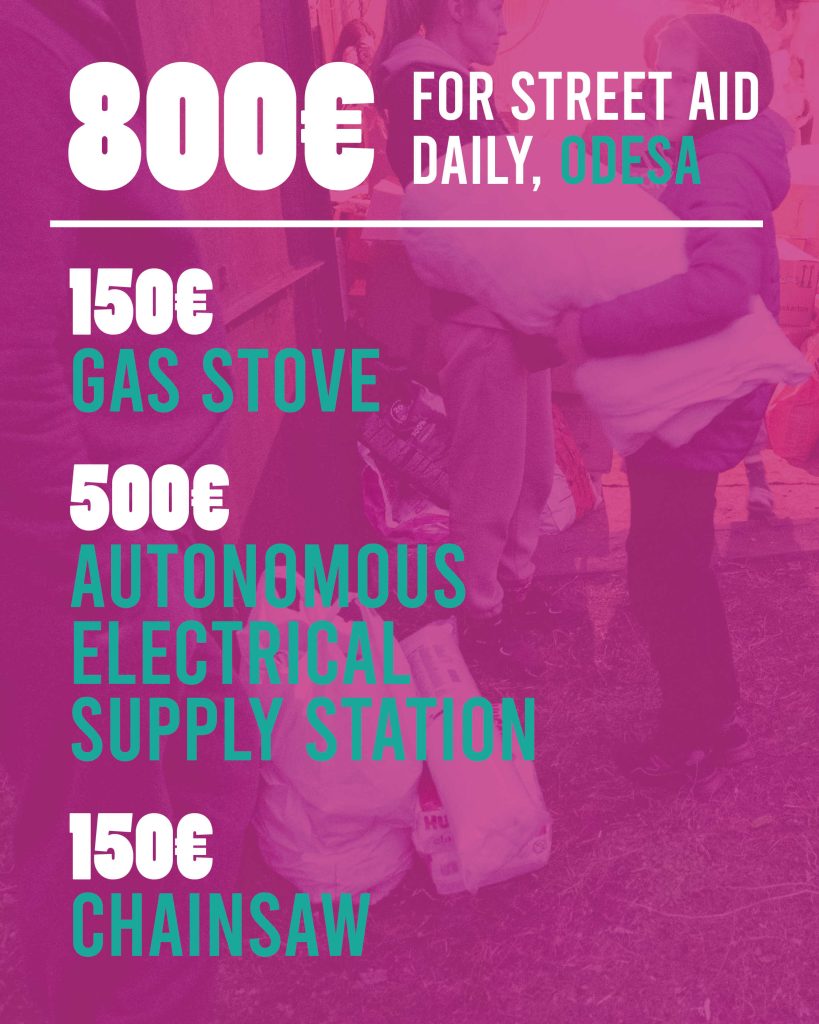
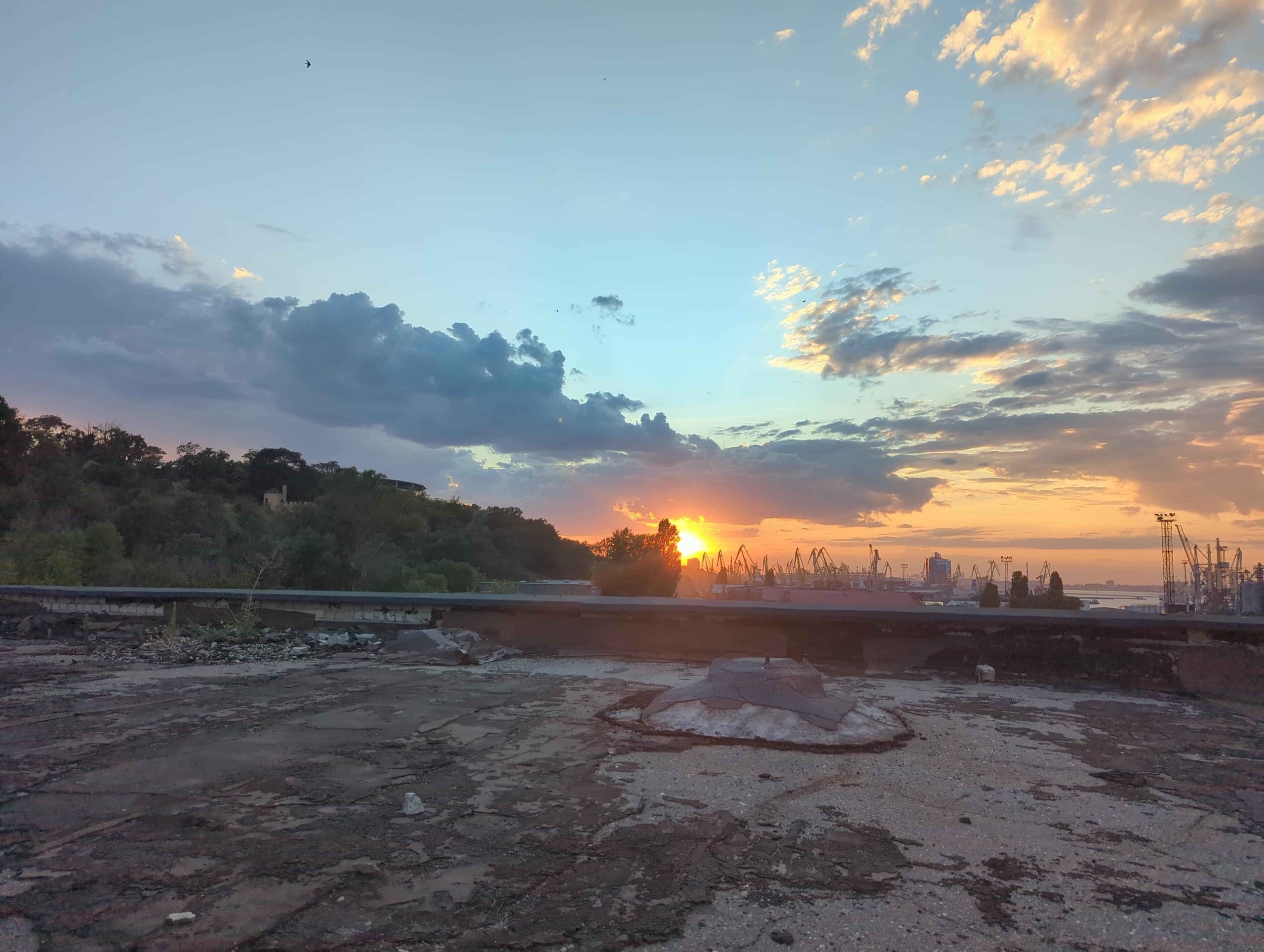
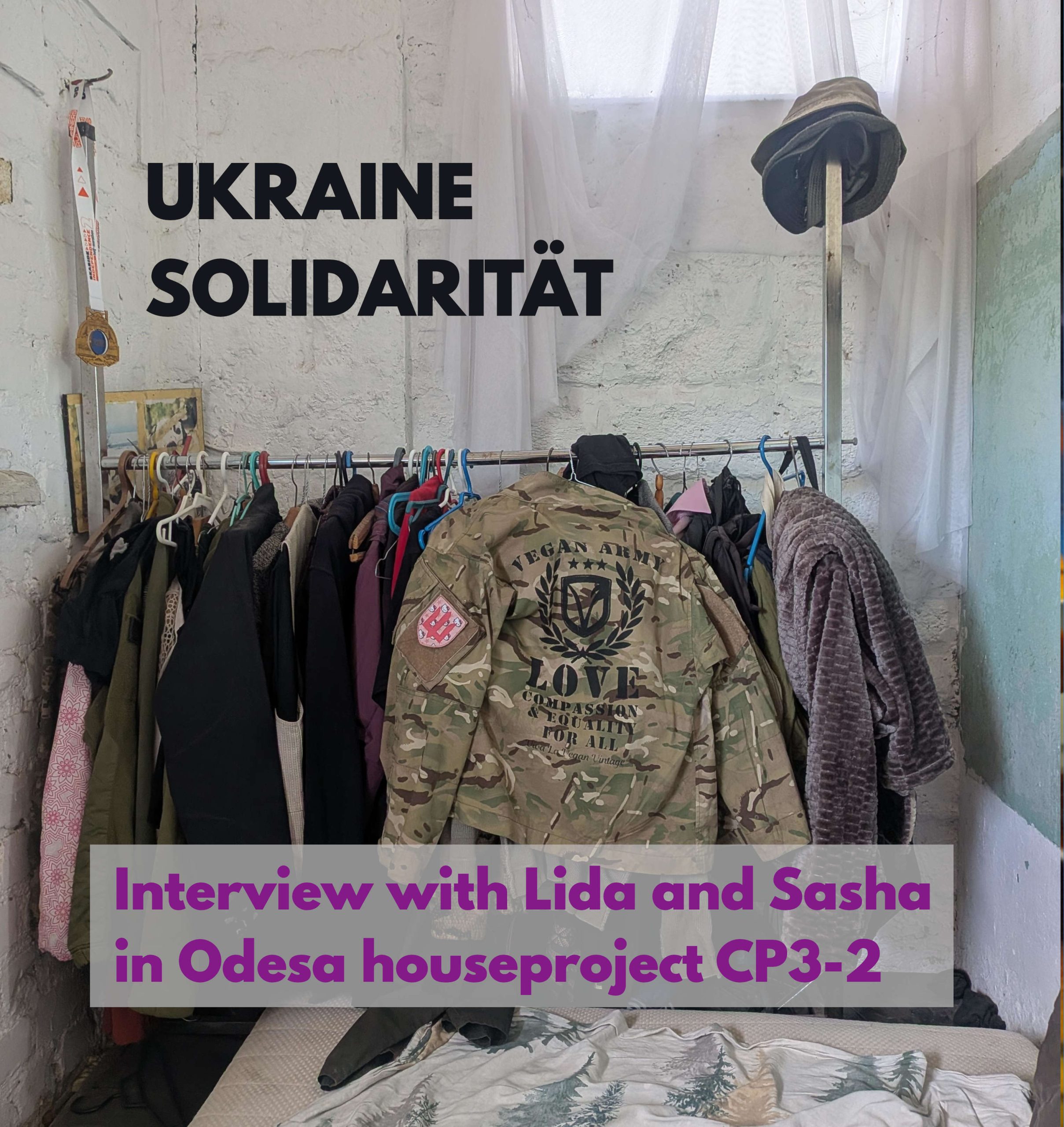
After a brief introduction, we jumped right into the Black Sea. The water was pretty cold, and the situation felt a bit surreal. The house, which is a communal space almost right by the sea, is located between hotels and an industrial area. As soon as we got out of the water, the air raid siren went off, and we heard an explosion, fortunately, far away. So we hurried back to the house and, on the way, took a look at the potential shelter. Afterwards, we were given a tour through the house and an overview of the work done by Street Aid Daily (SAD). This is an initiative that supports homeless people in Odesa. The house project serves as a storage facility for the donated goods that the initiative distributes on a regular basis.
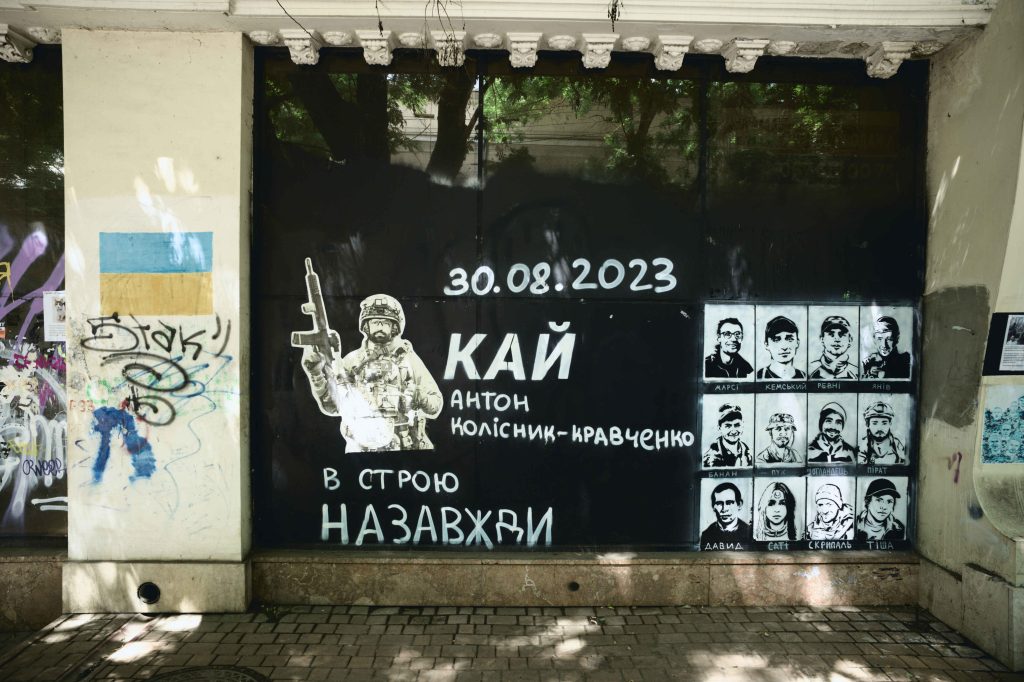
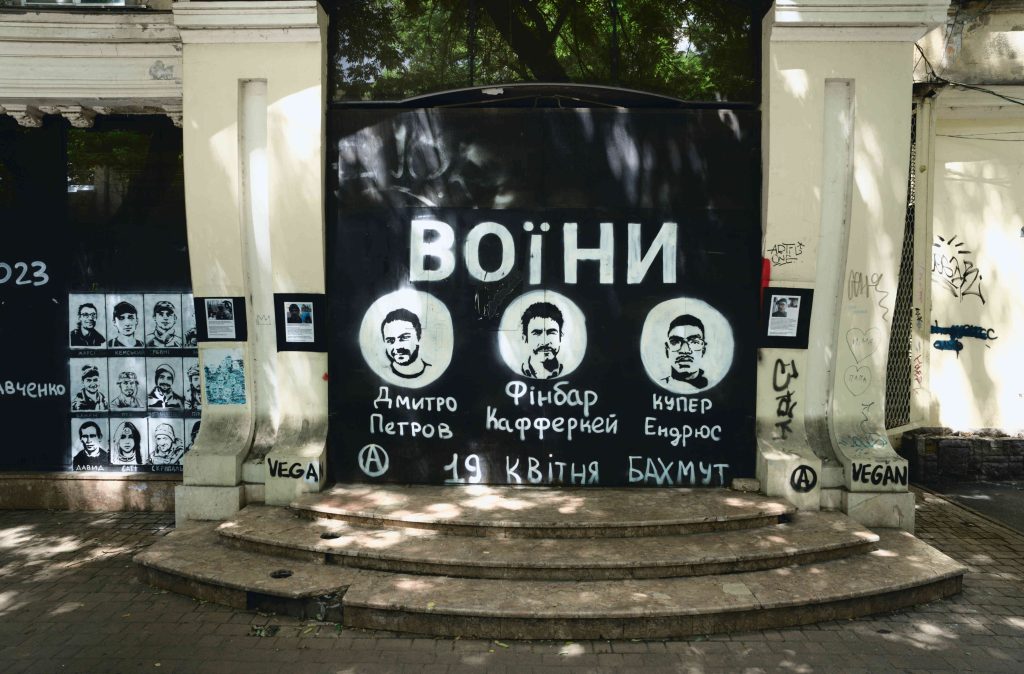
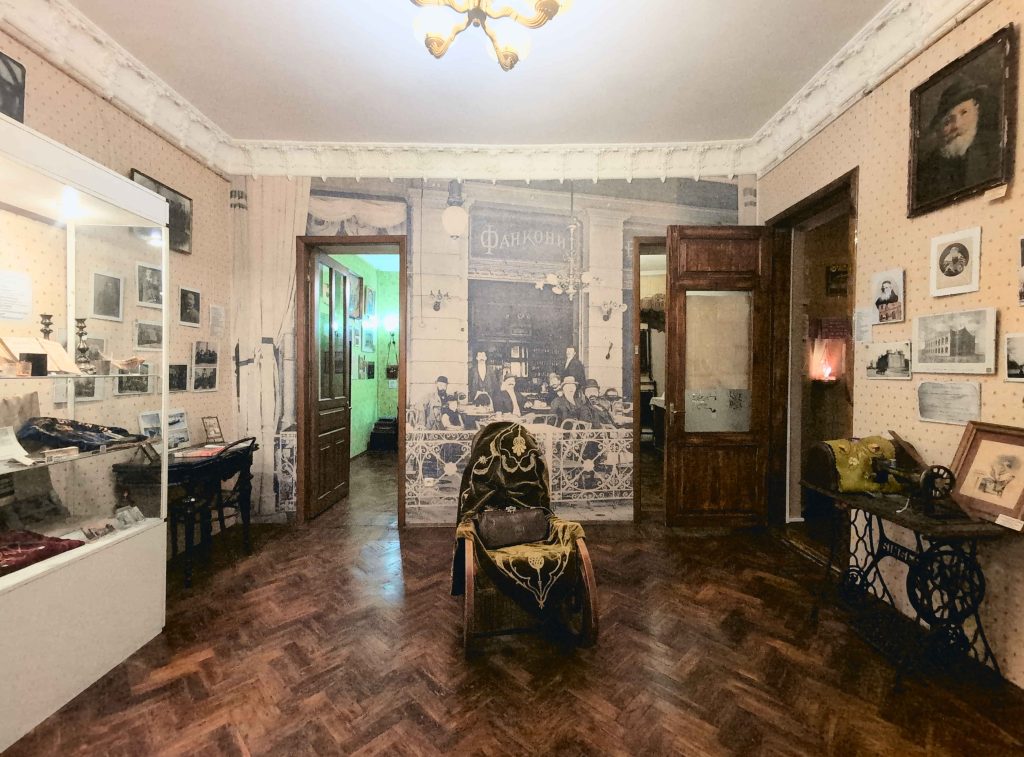
On Wednesday, we went to the Old Town, met up with a friend, had breakfast in the park, explored the city, and took a tour in the Jewish Museum. We found the graffiti in remembrance of the fallen comrades in the city.
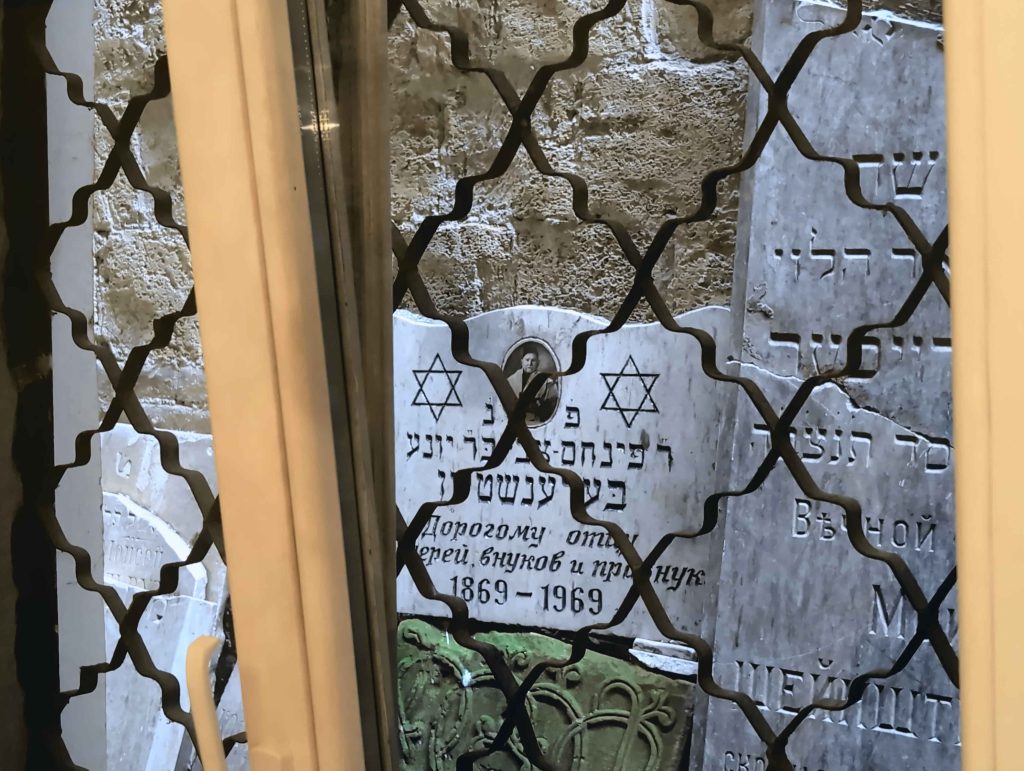
Odesa has historically been a cosmopolitan city with strong Jewish influence. In 1791, Empress Catherine’s anti-Semitic policies limited the area where the Jewish population was permitted to live in the Russian Empire to a strip in the west. The tchum-ha-mojschew, or Pale of Settlement, stretched from the Baltic Sea to the Black Sea. By the end of the 19th century, approximately 5 million Jewish people lived there. At the Jewish Museum, we learned that Odesa became a place of new opportunities in the 19th century, attracting many Jewish families. In the 1920s, the Jewish population in Odesa reached its peak of 140,000 people, accounting for approximately 44% of the total population of the city. Before World War II, Odesa had 80 synagogues. In 1941, however, the city was occupied by the Germans and Romanians. First there were pogroms and mass killings in the city, followed by deportations to the surrounding rural areas, where Odesa’s Jewish population was almost completely wiped out by mass shootings. We were very excited to visit the museum and wanted to learn more about Odesa’s Jewish history. Our guide at the museum is a sixth-generation member of a Jewish Odesa family still living in the city. Russia’s war against Ukraine is also having a profound impact on the mood within the Jewish community. With the start of the full-scale invasion, two communities have left the city. In an ironic twist of history, they found refuge in the two countries that were responsible for the Nazi policy of extermination in the region: Germany and Romania. Many have also emigrated to Israel. Currently, there are still three synagogues existing in the city. But there are only two communities that meet in one synagogue. They are fighting to preserve Jewish cultural life. During our visit to the museum, there was yet another attack on Odesa.
We organized an event on Wednesday evening, and people from outside the house also joined it. We gave a brief presentation on our solidarity work and how it is influenced by the political situation in Germany and the mood within the anarchist and leftist movements. We discussed and exchanged ideas about common strategies during the war, how decisions are made, and how dissenting opinions are handled. Afterwards, we watched short films that address the war and remembrance work. The meeting had to be paused several times because Odesa was attacked by Russian ballistic missiles that evening. Seven people were killed and several injured during the night. That evening, we met a wide variety of activists: some, who had been in the war and had been demobilized; some, who were planning to go to the front in the near future; and also some, who were trying to leave the country. A key part of all discussions about the war was about what everyone planned to do next. Our Ukrainian comrades showed great interest in political developments in Western Europe and were concerned about how the rise of the far right might further influence the anarchist movement.
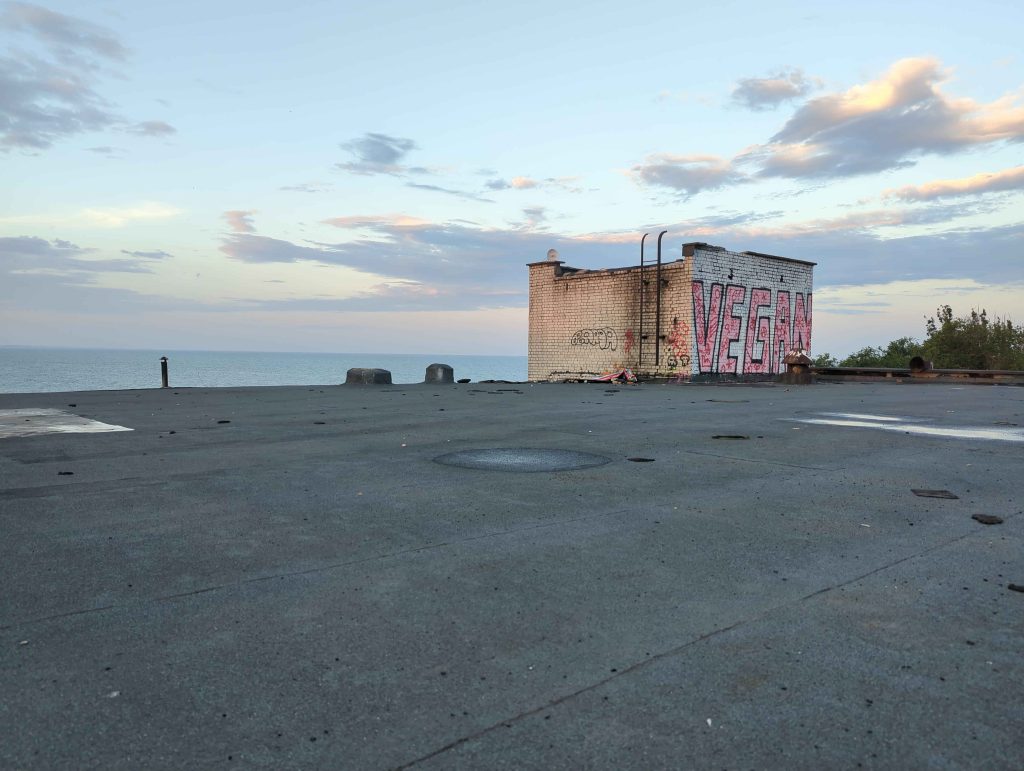
Before we left on Thursday, we went for one last swim in the sea. Our schedule was very tight, and our time at the house was far too short. We got to know a wonderful community that is very diverse and consists of various artists and activists. They have been organizing politically over the past six years and share common principles. The people in the house are united by two fundamental ideas: the right to housing for all and the right to life for all (the house serves only vegan food). We were deeply moved by how the residents show up for each another during these difficult times.
Finally, we headed to Kyiv, where we had plans to meet some friends for dinner. The situation in Kyiv has been very stressful in recent months. That’s what everyone we met has been teling us. The winter without electricity and heat is still taking its toll on many people and is affecting people’s health. The changed security situation is robbing everyone of sleep. In revenge for the destruction of Russia’s oil and gas infrastructure, the Russian Air Force is terrorizing Kyiv. More ballistic missiles are currently being deployed, leading to even greater destruction. The area around the Lukyanivska metro station (part of the long metro line located at the west bank of the river) looks terrible. In October, we met there several times, ate together, and shopped at the small market. Now everything is destroyed.
On Friday morning, a friend gave us a guided tour of Babyn Jar (also spelled as Babi Yar, and is a deep valley that served as the site of one of the largest mass murders of World War II). In 1941, the largest massacre of World War II took place here. 33,771 Jewish people (according to German statistics) were murdered here in just two days. This site was once on the outskirts of the city, but due to urban development, parts of the former Jewish cemetery and the killing site have since been built over. In total, approximately one hundred thousand residents of Kyiv from all ethnic groups were murdered here by 1943. Patients from the nearby psychiatric hospital who were murdered in a gas chamber were also brought here. We had already visited Babyn Yar during our last trip and discussed the design of the site. This is the subject of some heated debate. There are a lot of memorials there, including works by famous artists. However, many people feel this is inappropriate for a place where so many people died and believe that the space itself is already a memorial itself.
In the afternoon, we first met with Kyiv-based members of Prjama Dija, and then with people from Solidarity Collectives (SolCol) at their new office. Both initiatives talked about their current work, and we caught up on what has happened since our last visit.
So far, we’ve been lucky in Kyiv and have been able to sleep relatively peacefully. On Friday night there were rocket attacks and we had to go down to the basement for shelter. A major problem right now is that with ballistic missiles, people have about 3 to 5 minutes after the alarm goes off to get to safety. That night, the first rockets exploded before the air raid siren went off. So we went downstairs after the first wave of bombings and waited. Fortunately, that was the end of it, and we were able to return to our beds after about an hour.
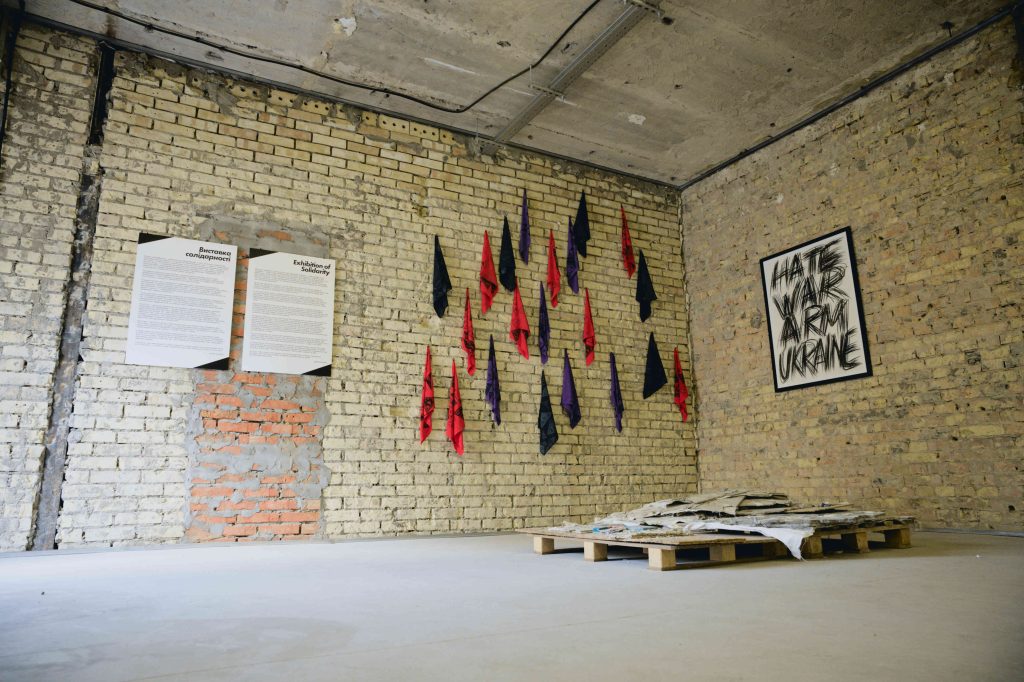
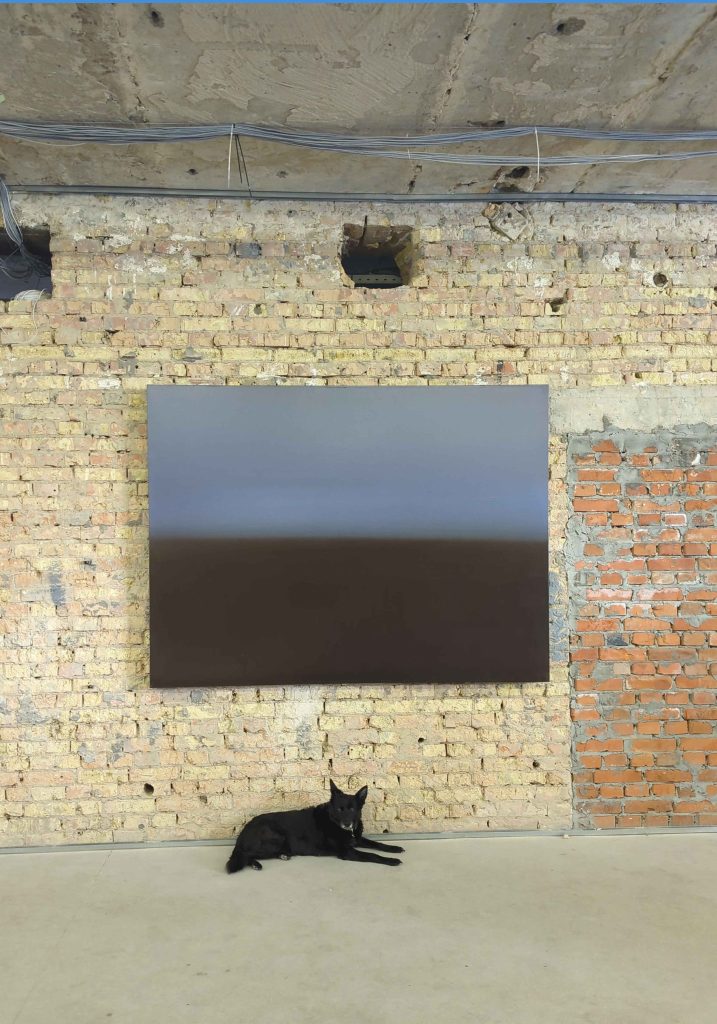
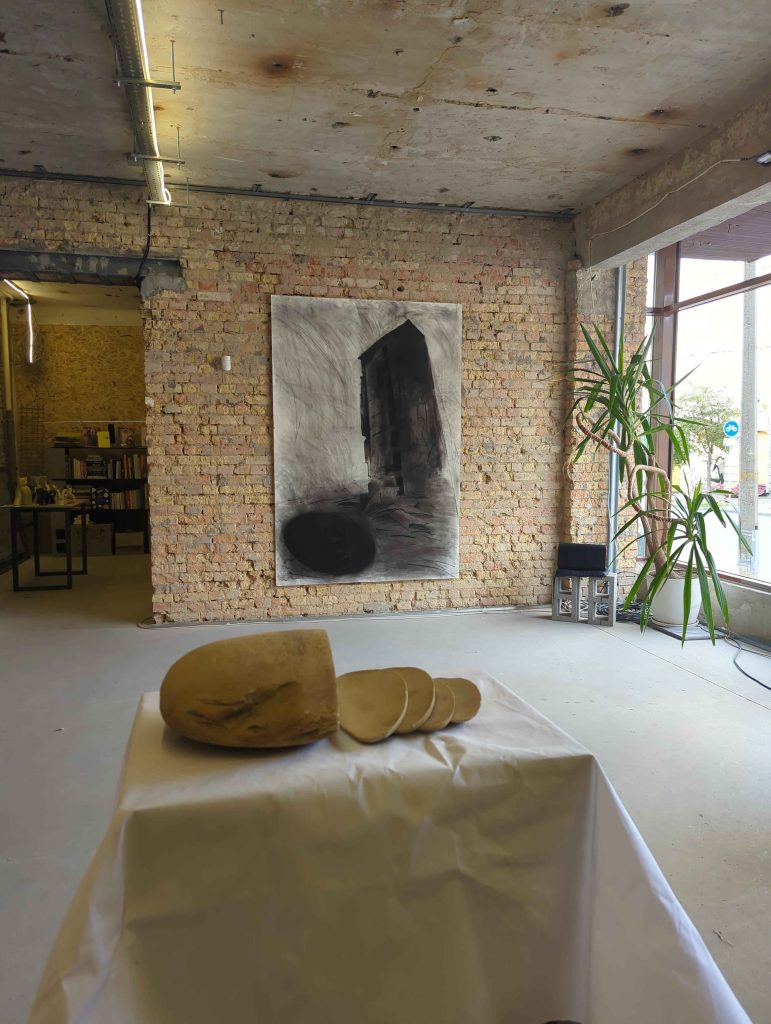
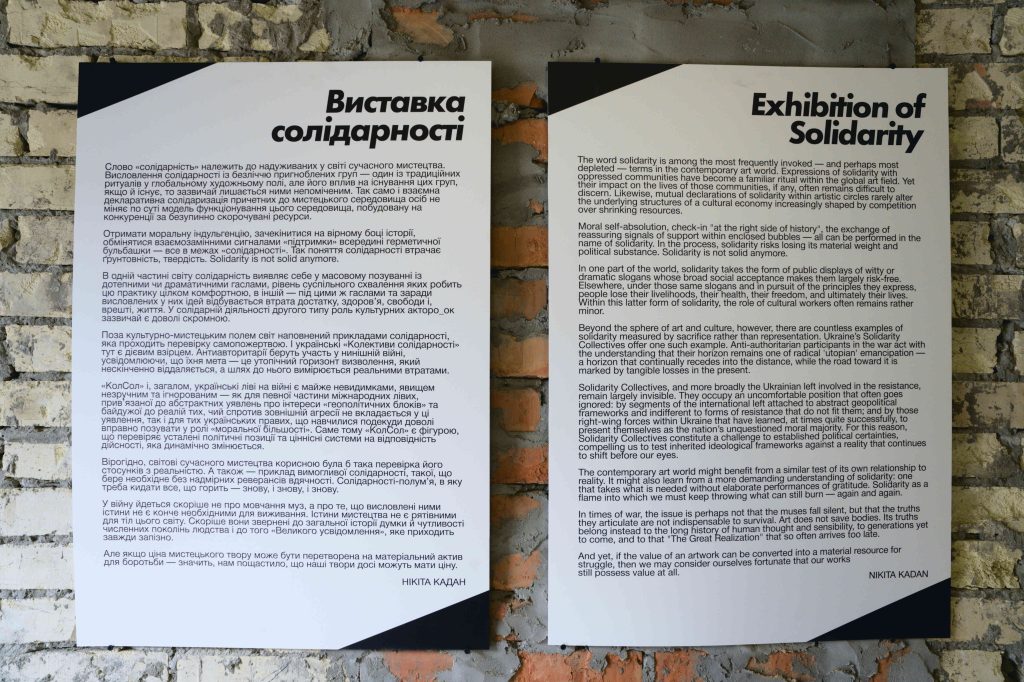
On Saturday afternoon, we stopped by SolCol again, checked out the DIY workshop for assembling (FPV) drones, and helped with some renovation work. Afterwards, closer to the evening, we went together to the closing event of the “Solidarity Exhibition” at the “Hinaus” gallery in the Podil district of Kyiv. The gallery organized an exhibition featuring contemporary Ukrainian artists in cooperation with SolCol. Above all, the exhibition helps SolCol become better known within Ukraine and raise funds through the sale of the exhibited works. One month before the exhibition opened, Podil district was severely hit by missle attacks, and the gallery was also almost completely destroyed. But with many helping hands, it reopened, even though in a somewhat improvised manner. The current atmosphere, however, enhances the impact of the exhibition, which explores the war from various artistic perspectives.
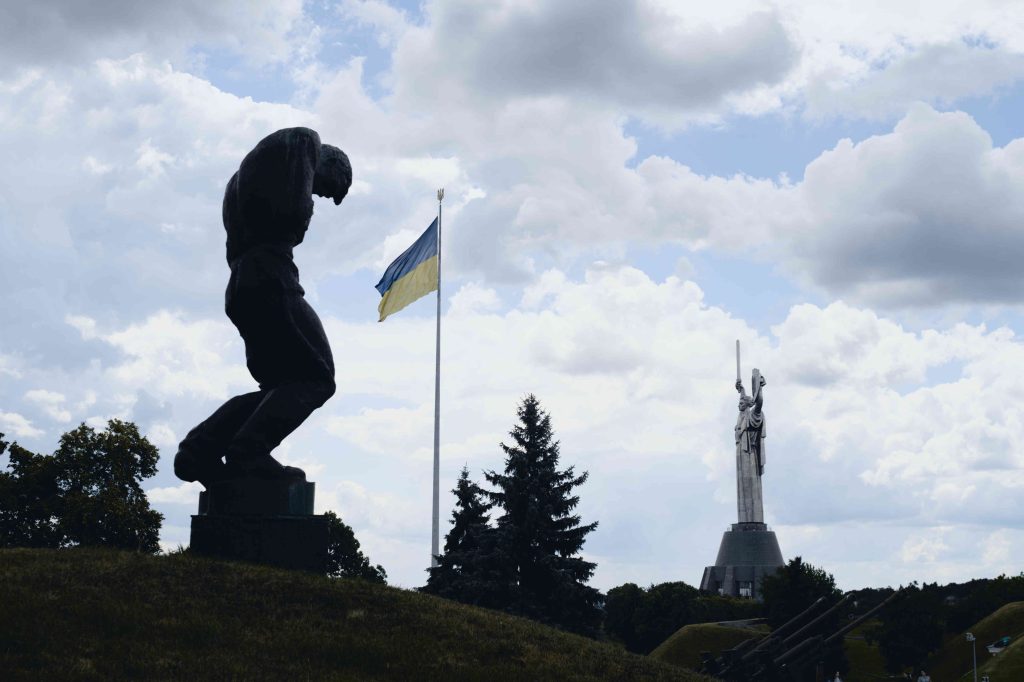
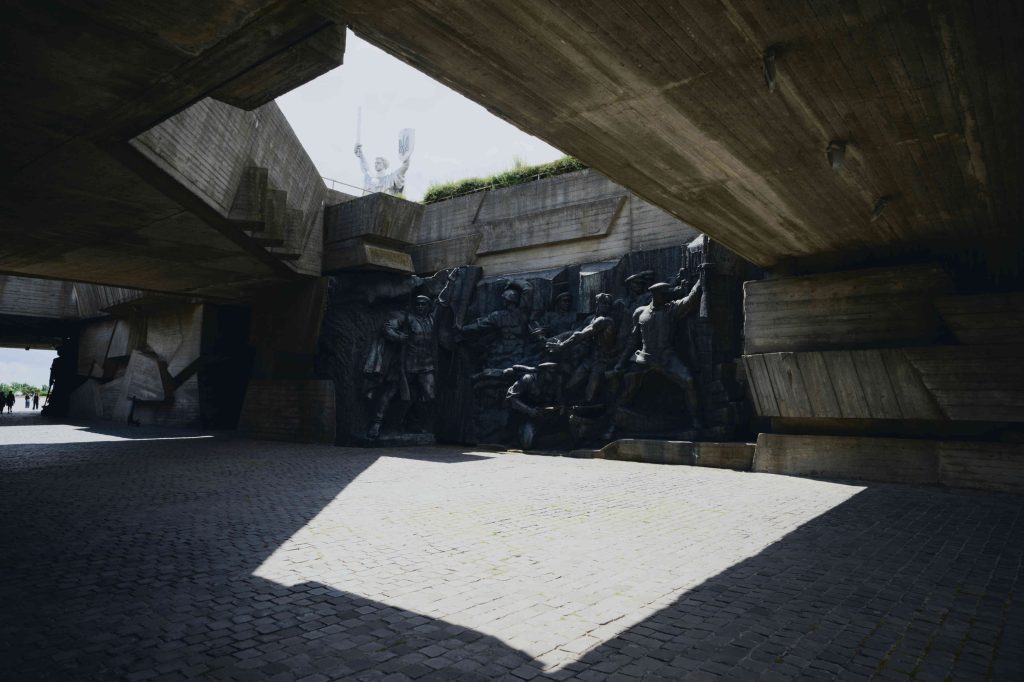
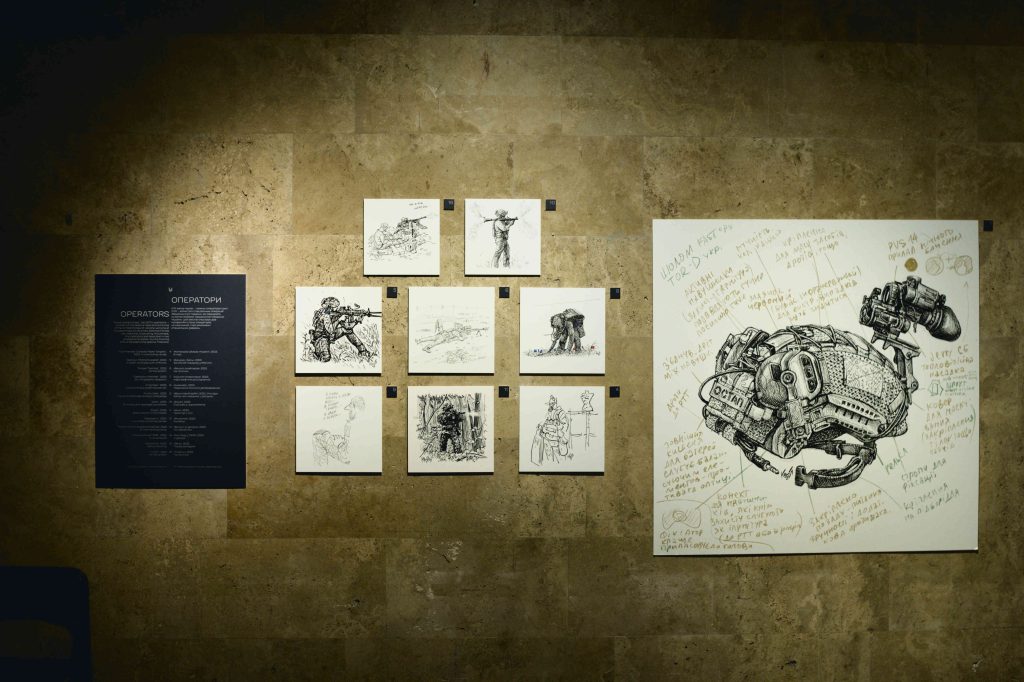
Sunday was Museum Day again. We walked across the large outdoor grounds past Soviet sculptures, and where also military equipment from World War II and the present day is on display. We wented to the massive statue of “Mother Motherland.” It symbolizes the Red Army’s victory over Nazi Germany, and the War Museum is housed within its pedestal. The exhibits there evoked very mixed feelings in us. First, there was a small exhibition marking 10 years of the Ukrainian Army’s special forces, presented in a comic-book style that was highly glorifying. Another exhibition part tells the stories of international volunteers in the Ukrainian Army, who have very different motivations and political views. Though the exhibition does not address these differences. “War: Inverse Perspective,” on the other hand, showcases various artistic approaches to World War II and the Russian invasion. In the exhibition’s entrance area, visitors walk through a Socialist Realist relief to then look “inside.” The exhibition featuring three female artists from Ukraine and Germany was also fascinating. One of them discovered through a photo album that her grandfather had been stationed in Ukraine as a Wehrmacht soldier and had taken many photos from the occupiers’ perspective, some of which look like tourist snapshots. This is contrasted with the perspective of Ukrainian family history under the occupation, supplemented by several artistic works by the current generation. Overall, there are currently very different ways of engaging with the topic of war at this location.
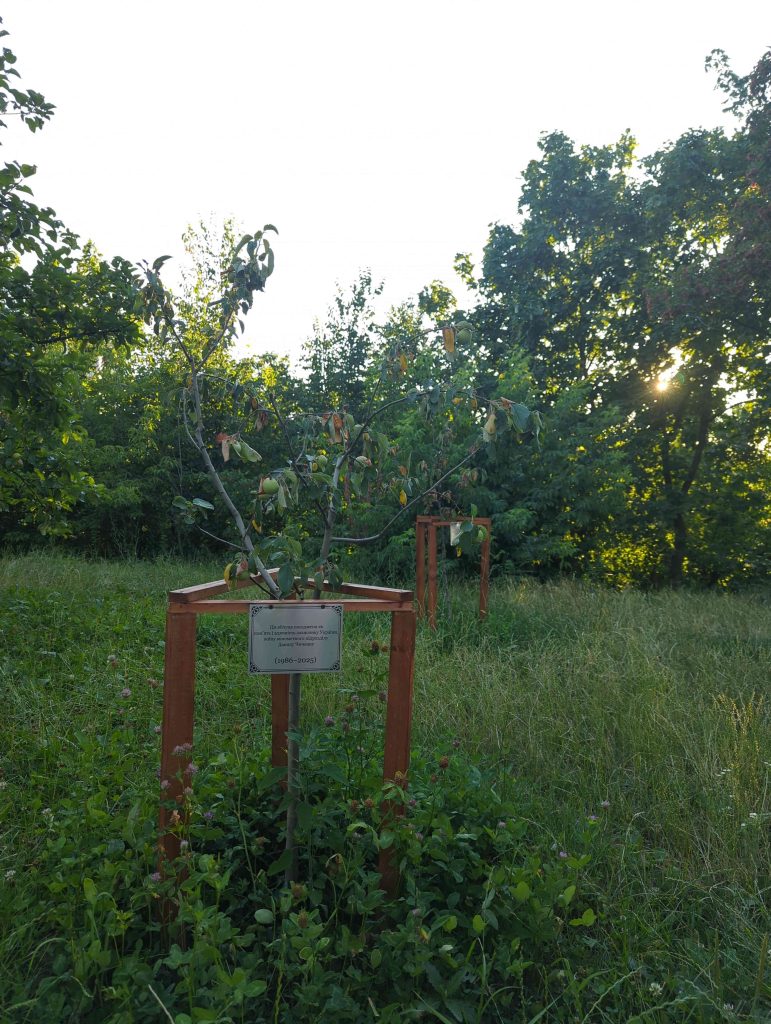
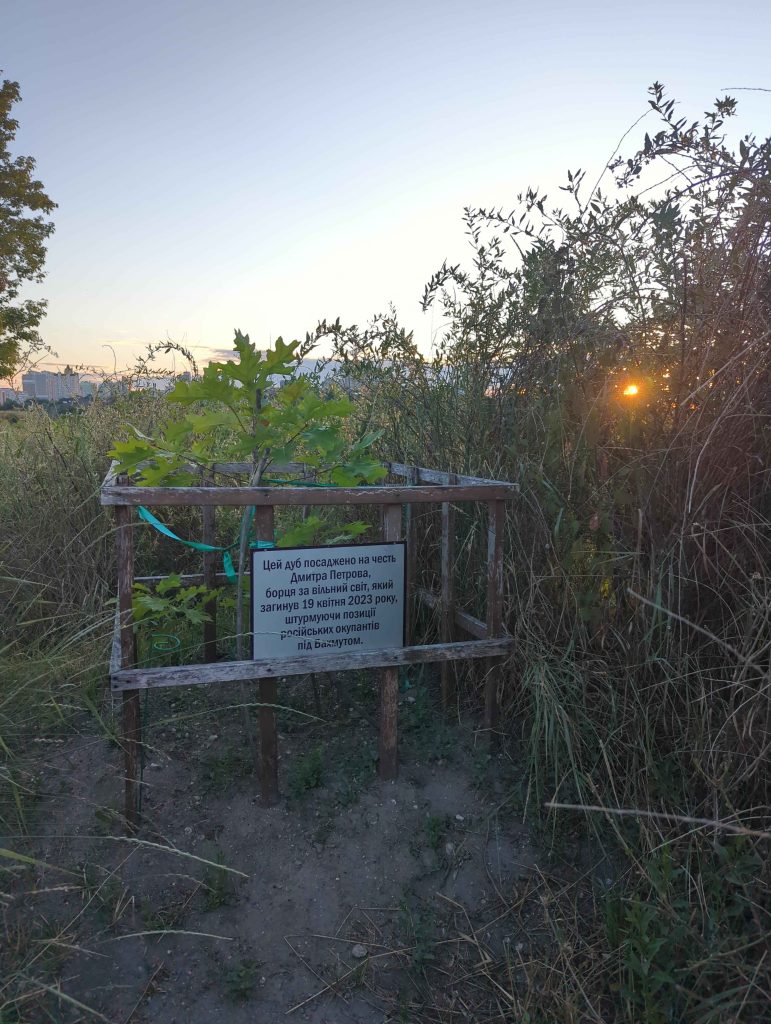
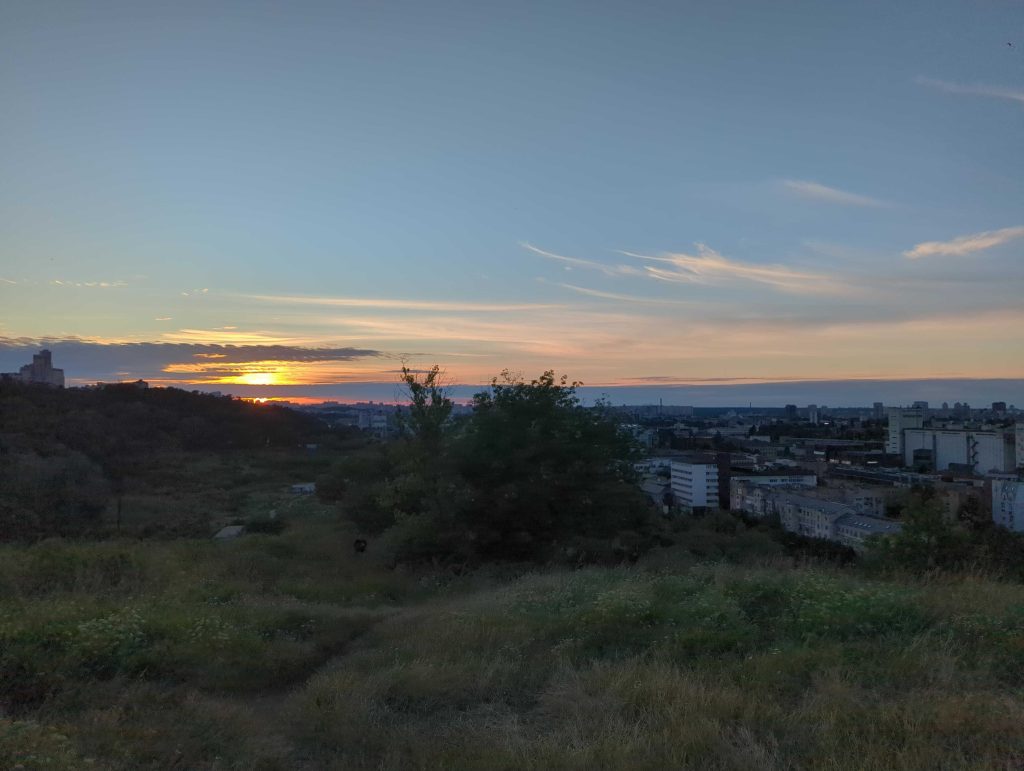
At sunset, we visited two sites where memorial trees had been planted for fallen anarchists. After more than four years of war, there are various ways of dealing with loss within the movement. Solidarity Collectives have also created and published a zine on this topic: https://www.solidaritycollectives.org/en/zine/
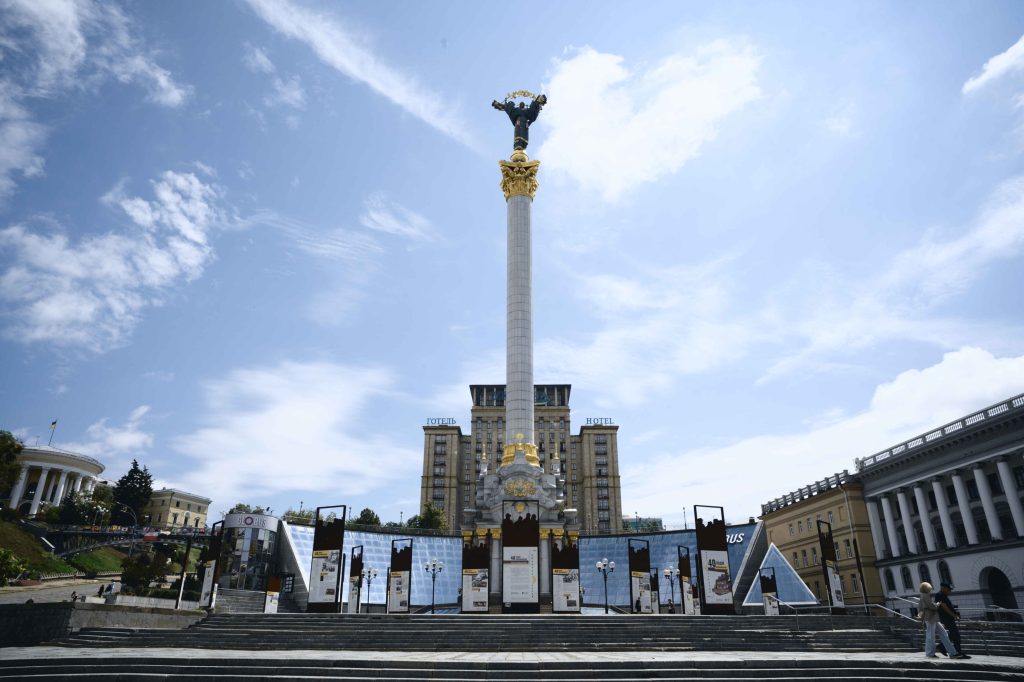
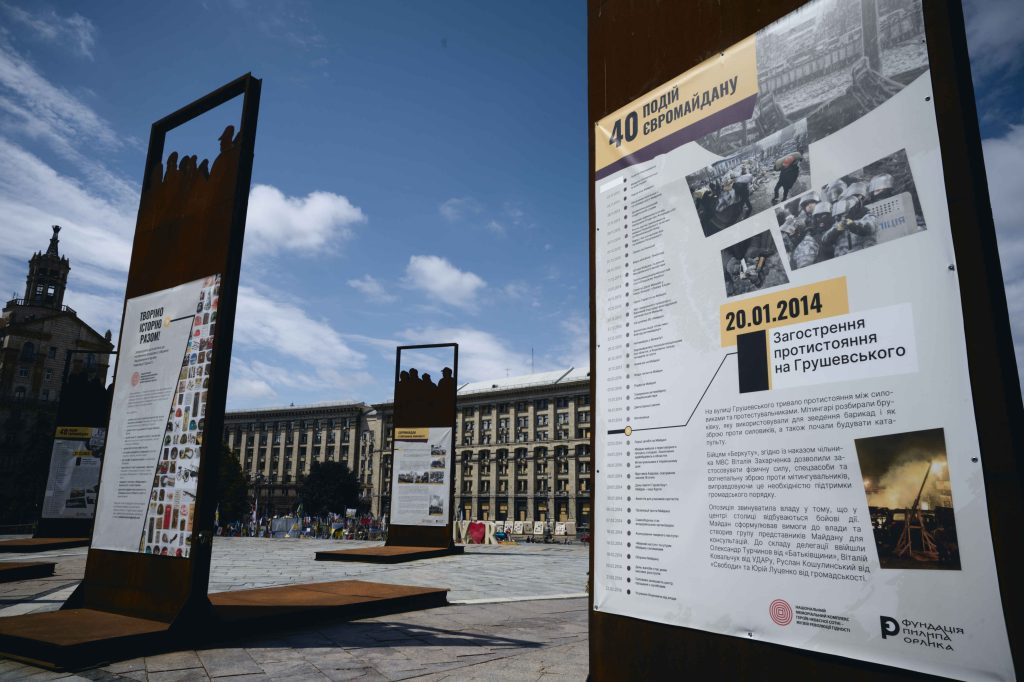
On Monday, we took a walk through downtown and across the Maidan, Independence Square, and viewed the exhibition on the 2014 revolution. It was moving to be interrupted by a funeral procession. Often, fallen soldiers are driven through their city to the cemetery in a convoy accompanied by flags and sometimes music. As the procession passes, people pause at the roadside to show their respect.
Overnight into Tuesday, there were several ballistic missile attacks on Kyiv, but they were (largely) intercepted by air defenses.
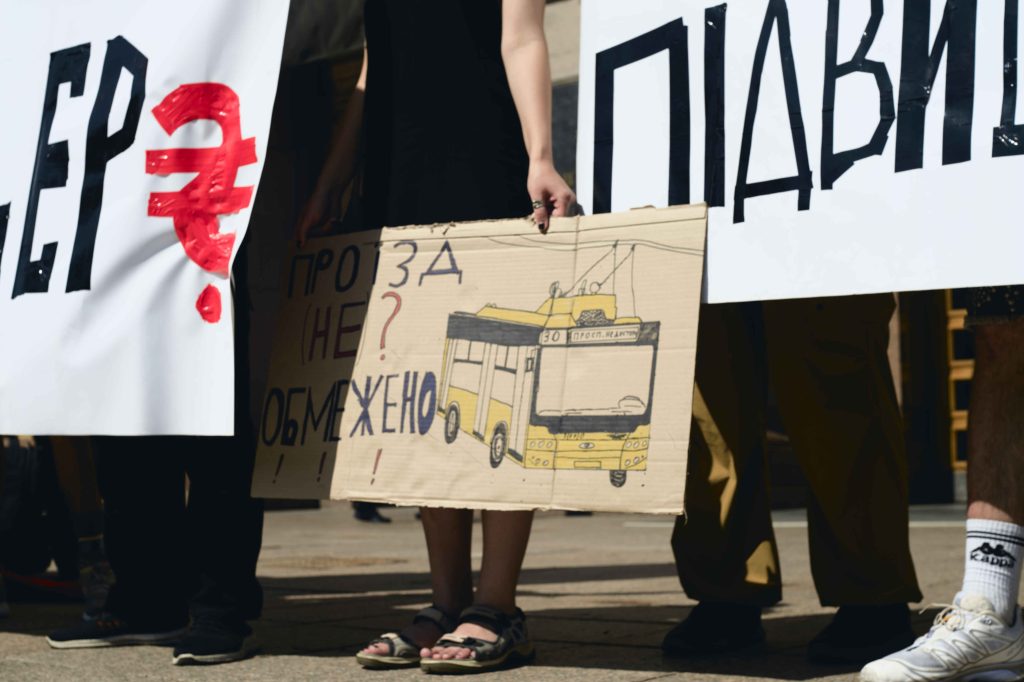
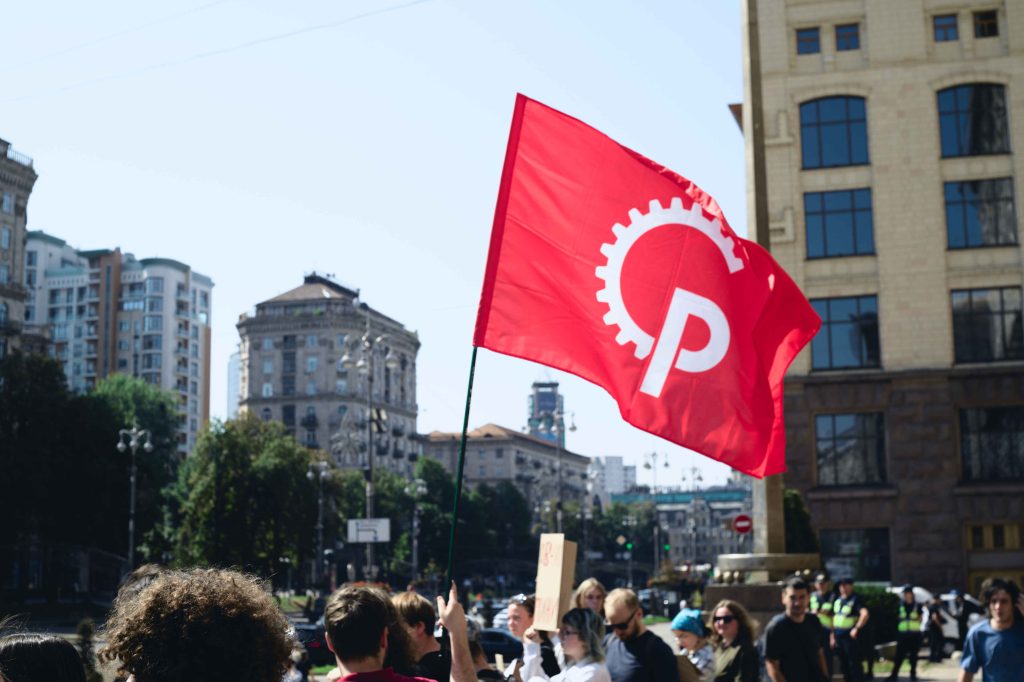
In the morning, a meeting was held at Kyiv City Hall regarding plans to make the public transport ticket prices three times higher. Outside City Hall, Socialny Ruch (Social Movement group) , with the support of the student union Prjama Dija, organized a protest against this, in which we participated as well. Slogans such as “Bread or a metro ticket?” and “Are you a mayor or a thief?” were chanted. Speakers emphasized the connection to the extremely high rents in Kyiv: those who cannot afford an apartment in the city center are most dependent on the metro. In addition, a participant of the 2014 revolution reported that the rising prices hit the elderly particularly hard because pensions are very low and do not keep pace with inflation.
In the afternoon, we visited the Folk Architecture Open-Air Museum, where pre-industrial villages from all parts of Ukraine are on display. Unfortunately, the houses were closed that day; otherwise, we could have learned a lot about traditional crafts there. Even so, it was very interesting and, at the same time, relaxing to get away from the bustling city.
Before heading back to Dresden, we met up with members of Solidarity Collectives and Prjama Dija for a farewell dinner.
It was once again a very moving trip filled with many impressions and encounters. They showed us that solidarity changes perspectives, strengthens exchange and connections, and brings people closer together. Many thanks to everyone who made this possible and supported the fundraising campaign.
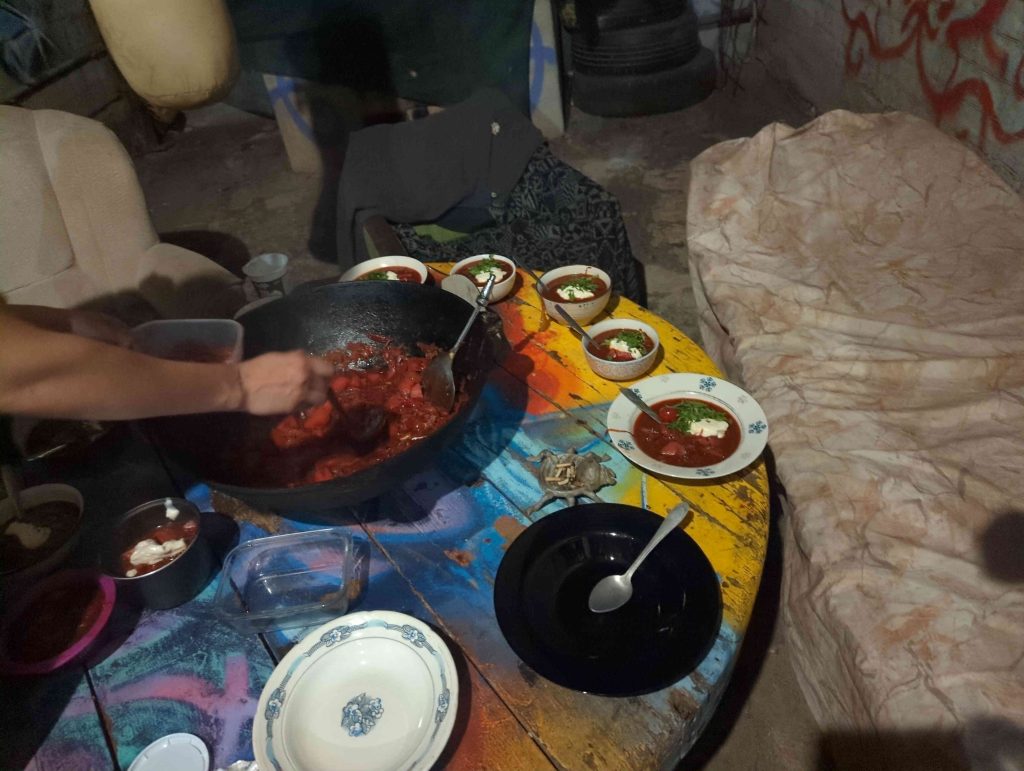
We wanna collect 1500€ for CP3-2 to fix the roof and other needed reparation
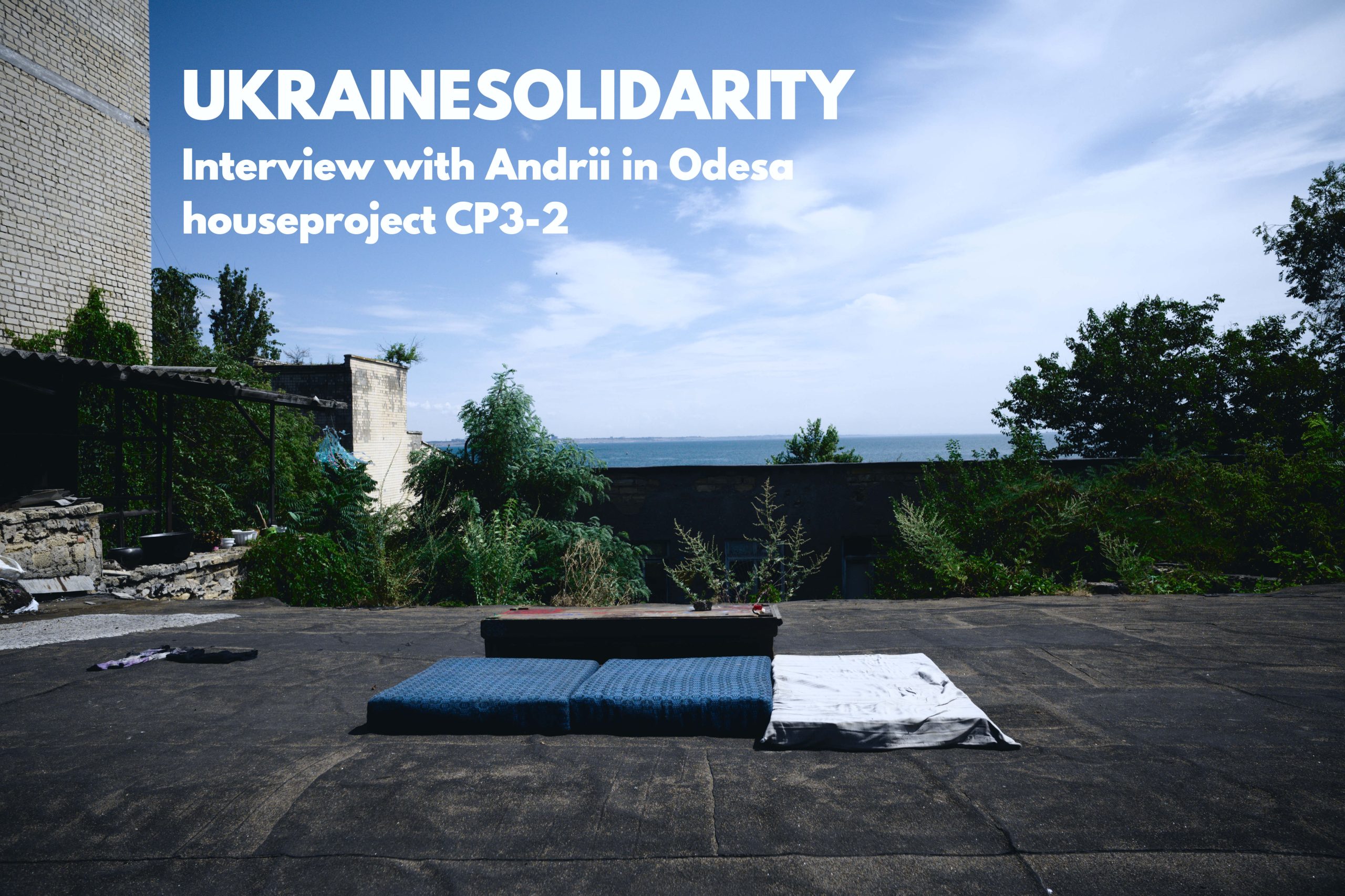
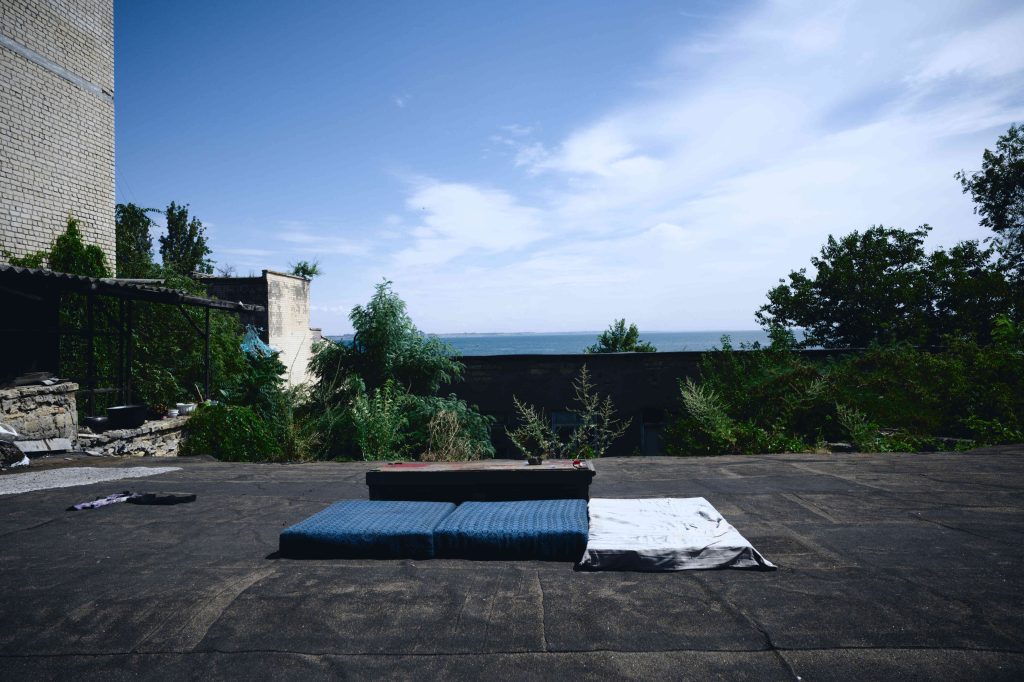
Located in the heart of Odessa is the CP3-2 housing project, which has been collectively run for several years. The space serves as a hub for art and culture, as well as living quarters for various activists and artists. Due to the war, the building – like much of Ukraine’s infrastructure – is in poor condition as a result of constant bombardment and a lack of financial resources. That’s why we need your support!
The most urgent repair project right now is the roof! Before winter sets in, major roof repairs are scheduled to be carried out in the fall of 2026. There are also many other problem areas in the building. For example, the windows have to be reinforced every time after bombings.
We’re traveling to Odessa in July to support the project and bring a donation to purchase necessary materials.
We were already in Ukraine last year on a delegation trip to meet various people and projects and provide necessary support.
We’re calling on you to donate a small amount. Support this self-organized community space, which—despite the war—offers a place for exchange, art, politics, and solidarity.
All donations go to the projects´s collective and will be used for roof maintenance and other repairs.
At the end of October 2025, a small group of activists from Dresden — members of Anarchist Black Cross, malobeo, FAU and Queer Pride — set out on a solidarity trip to Ukraine. We packed a van full of materials collected in Dresden and hit the road, not just to deliver supplies, but to connect with people and collectives who, in their own ways, are resisting the Russian full-scale invasion. Our goal was also to learn and to listen to those living through the war, to exchange stories and experiences, and to weave stronger networks of solidarity.
The journey starts with a long drive toward the Ukrainian border — which somehow feels shorter than the five hours we spend waiting to cross it. Late that night, we finally reach Lviv, where Shelter from the Lviv Vegan Kitchen opens his doors to us.
Shelter is a vegan activist, food relief enthusiast and volunteer army combatant. Right after the beginning of the full-scale invasion, he joined a territorial defense unit, but after a couple of months, he returned to Lviv to become a vital part of Lviv Vegan Kitchen collective. At the same time, Shelter is now serving on rotation basis in a voluntary artillery unit. One reason to join a voluntary unit was also to have bigger freedom of choice where to go and what to do.
In wartime, people find their own ways to help — their own spaces where they can feel they’re contributing something. For the crew behind Lviv Vegan Kitchen, that space is food. The collective formed in the early days of the full-scale invasion in 2022, when thousands of refugees were fleeing west. They decided to cook for them, funding everything entirely through donations.
Until June 2024, the kitchen served up to 500 hot meals a day to internally displaced people. When donations ran dry, that part of their work had to stop — but the collective didn’t. They realized there was another gap to fill: food for vegans on the frontline. Military rations provided by government are not vegan and in case there is a kitchen in the unit, meat or cheese are being mixed in the dishes so there is no vegan option.
So the kitchen started to cook, bake and send packages to the front – falafel, seitan, syrniki (Ukrainian curd pancakes), cookies, and other durable vegan meals that can survive long journeys and rough conditions. They even came up with their own protein bar recipe, which, according to soldiers, is a huge hit.
We visit their storage space. It’s DIY, improvised, and full of heart: shelves stacked with carefully labeled bags and boxes, a chest full of vacuum-packed seitan and falafel. Everything run with surprising order and precision. Here, Shelter prepares the packages with vegan ready-made food but also fills zip bags with basic spices, makes sets of instant soups and tomato paste, weighs out yeast flakes and soy granules; so soldiers have everything to prepare themselves a decent vegan meal. To receive a package from Lviv Vegan Kitchen, they only need to fill out an online form — and somewhere along the supply line, one of Shelter’s packages will find its way to them.
On the long drive to Kyiv, we download mobile apps that send alerts about air raids. You can choose which regions you want notifications for. We also join a handful of Telegram channels, some run by volunteers, others by official institutions, that post updates whenever missiles or drones are detected. Not long into the drive, our phones start buzzing and wailing one after another. Air raid alert for Kyiv. Air raid alert for Sumy region. The app politely advises us to “find the nearest shelter and stay calm.” We’re not even close to those regions yet, but the nonstop alarms become too much. We switch our phones to silent and pretend not to notice. The alarm stops with a person from the phone announcing: “May the force be with you.”
By the time we roll into Kyiv, the city of nearly three million feels strangely calm. Public transport stops at 10 p.m., metro stations close soon after, and by midnight the curfew empties the streets.
The next day, we meet two members of the Student Union Priama Diia, which translates as Direct Action. One has long curly hair tied back in a ponytail and wears a sweater that reads NO PHOTO. The other, with a shaved head and dangling earrings, smiles as they wave us over at the metro station. Across the street, we see a factory, which is bombed on a regular basis, without glass in the windows.
As we walk together through the neighborhood, we pass another burnt-out building. But around it, life moves on — people heading to work, carrying groceries, chatting at market stalls. In spite of the ongoing war, Kyiv is very much alive.
We arrive at a self-organized space inside the art university. The room feels both improvised and full of care — we sit down on DIY sofas made from wooden pallets, covered with a colorful crocheted blanket, next to a small bookshelf stacked with zines and books. Abstract geometric paintings hang on the walls, and smaller pieces are displayed on minimalist shelves. It feels like a living room gallery or a social center.
The student union Priama Diia has been around since the early nineties, passing through several generations of activists, ceasing to exist just to be reborn after some years. The two members tell us how, in 2023 — a few months after the start of the full-scale invasion — they began rebuilding the union from just three people. They saw how urgently students needed a voice, especially in the time of war. Now there are around 300 members across different cities in Ukraine.
Their work ranges from fighting scholarship cuts and dormitory evictions to confronting psychological abuse and power imbalances from teachers. They push to make education fair and accessible — “for the benefit of students, not the deep pockets of the one percent,” as they put it. They organize events, protests, and publish zines about how students live and find strength for activism during the war.
On the table in front of us, the two members spread out the union’s stickers and flyers. A black cat appears again and again — in one version inside a circle, echoing the antifascist logo; in another, it’s wearing a pink bowtie and reads “Solidarity” in Cyrillic. Hello Kitty with an AK-47. Marx Bubu in a bunny onesie. Nestor Makhno.
For the union, education isn’t a privilege or a commodity. It should be free and accessible for all. It should be anti-capitalist. They see the student struggle as part of the wider labor movement — not just a fight for better study conditions, but part of the broader struggle for human liberation.
You can learn more about Direct Action Student Union here: www.priama-diia.org
In the afternoon, we meet several activists in the office of Solidarity Collectives. Above us hang anarcho-feminist and antifascist flags; on a shelf a painted portrait of the Russian anarchist Dmitry Petrov who died in 2023 in Bachmut fighting Russian imperialism; on the floor, a few paintings by the Ukrainian anarchist artist David Chichkan, who was killed this year at the frontline. One shows three soldiers with anarcho-feminist and anarcho-syndicalist flags on their uniforms — small emblems on their chests and sleeves. Behind them stretch white clouds across a blue sky, and within the clouds, a faint portrait of Nestor Makhno, as if the sky is mirroring an inspiration of the current struggles.
We meet Iryna from Feminist Lodge. That’s a grassroots initiative founded in Kyiv in 2017 that promotes gender equality. Since the beginning of the war, they’ve shifted their focus to helping vulnerable women and their families with humanitarian aid, distributing it across the countryside—including temporarily occupied territories — and to internally displaced people.
We meet Andriy from Sotsіalniy Rukh (Social Movement), a Ukrainian left-wing organization that supports workers across industries — from mining and transport to healthcare, education, and IT. In 2022, they called on the international left to support Ukrainian resistance to Russian imperialism and spoke out against the government’s wartime rollbacks of labor rights.
Then we meet Mykola from Solidarity Collectives — yellow curls, small silver earrings across the earlobe, a retro jogging jacket that would fit right into Berlin, and black cargo pants. He looks tired, smoking hand-rolled tobacco.
The collective consists of anti-authoritarians who came together when Russia’s full-scale invasion began. They support anti-authoritarian comrades fighting on the frontline and those affected by the war — providing humanitarian aid, building FPV drones, and support animal rescue.
Mykola tells us about the endless rotation of volunteers, a too small group of active people, how everyone is tired. At the start of the invasion, he worked in humanitarian aid, driving to bombed-out villages in the east to bring materials and help displaced people rebuild their homes. One day, he returned to find those same houses reduced to rubble again, their inhabitants once more forced to flee. The futility of Sisyphus work hit him hard. Now, he builds drones for anti-authoritarian soldiers at the front.
What connects all the collectives we meet today is a deep exhaustion. After nearly four years of war, burnout has become one of their biggest challenges. There’s always another crisis, another person who needs help. No time to rest after their work and activism. Yet through all the fatigue, they remain kind and patient — their smiles sometimes delayed, but genuine when they arrive.
Suddenly, a power outage. These happen often now and are increasing due to the Russian attacks on Ukraine’s energy infrastructure. Sometimes they’re planned, sometimes not. Local energy suppliers or the municipality provide tables of planned outages on their websites or Telegram channels, so people can get prepared.
For the night following our meeting at Solidarity Collective’s office, a massive air attack is expected. Telegram channels fill with warnings. Locals seem unfazed: “Air alerts happen every day,” they say, “you can’t live in a shelter forever.”
Around 1 a.m., one of the comrades wakes us. We quietly gather our things, step into the cold, and head to a nearby garage serving as a makeshift shelter. We spread our mats behind parked SUVs, slip into our sleeping bags, and listen to the sirens and the distant rumbling of air defense. Or is it someone snoring, and we’re making it up? A family with small dogs passes by, carrying their own camping things. We spend the night there.
By morning, we learn it was one of the biggest aerial attacks since the start of the war — over 700 projectiles, among them drones, cruise missiles, and decoys raining across the country. We open a picture of visualized attacks through this night, and the whole map of Ukraine flares: Strike UAVs “Geran-2/Harpyia,” cruise, ballistic, and air-launched ballistic missiles — “Kh-101, Iskander-K, Kalibr,” “Iskander-M,” and “Kinzhal”, decoy drones identified as “Gerbera.”
Some of us look up the military terms online, still unsure what they are and what they mean. The official statements say Russia is targeting energy infrastructure and “military objects,” but factories, homes, and civilians are hit just the same.
Later, we visit Maidan Nezalezhnosti (Independence Square) which is a deeply historical, emotional place for Ukraine: A wave of demonstrations and civil unrest, the “Hundred Dead of the 2014 Revolution”. Today, rusty barricades from the uprisings ornament the side of the road, together with informational signs, describing the riots, a flash photo of a crate with Molotov cocktails.
The square features a large red monument that reads I ♥ Ukraine, reminiscent of the I ♥ Paris or I ♥ London signs. Around it stretch thousands upon thousands of yellow and blue flags, each bearing the name of someone killed in the full-scale invasion. Here and there, clusters of other flags appear — those of the U.S., Georgia, Belarus, and in one small corner, a few anarchist flags. We see a portrait of a young person known by the nickname “Anarchia”.
Workers, or perhaps simply locals who care for the place, gently pick fallen leaves from the yellow-and-blue plastic flowers and sweep the ground. People move quietly along the narrow paths of the memorial. A man with a prosthetic hand stands motionless on the steps, crying. He limps through the sea of flags marking the dead. The gendered violence of this war — mostly directed at male bodies — hits painfully.
From Maidan, we take the metro to Babyn Yar, where we meet our other comrades.
The park is quiet and vast, the trees shedding their yellow and orange leaves onto the ground. Monuments are scattered around. It’s a terrifying place. 33,771 Jews (according to the murderers) were slaughtered in two days during World War II, more than in any other single massacre committed by the Germans. All in all, between 1941 and 1943, the Nazis murdered approximately 100,000 people, including almost the entire Jewish population of Kyiv, in the ravines, which were located here before, during Soviet Union, the whole area was remodeled. Babyn Yar is a dark landmark on the map of the Holocaust — the site of the largest mass shooting carried out by the Nazis during their campaign against the Soviet Union.
We pass a rusted iron structure shaped like an old Romani wagon, wrapped in a chain of iron flowers, some candles on the stones underneath it. It’s a monument to the Roma killed in Babyn Yar. Behind it stands an old tractor, ready to maintain the lawns and trees next to it.
We walk deeper into the park. Joggers pass us, people walk their small dogs, life quietly continuing around a place of unimaginable horror. We reach a contemporary audiovisual installation called Mirror Field, about the size of a small basketball court. It’s made of stainless steel — a circular mirrored platform with ten tall columns rising from it. The surfaces are shot through with bullets of the same caliber the Nazis used here during the executions.
The description of the installation says that at its center is the symbol of the Tree of Life, found in so many religions and myths. The tragedy of Babyn Yar shows how easily this tree can be destroyed, its branches broken. From the columns, organ-like sounds emerge — music made from the names of victims, turned into tones. We walk slowly across the mirrored surface, looking at our shot-through reflections, listening to echoes of Yiddish songs from the 1920s and 1930s. We can’t escape our own reflections.
In the evening, we take the metro to Podil, a vibrant neighborhood in Kyiv. Someone needs a bathroom, and a comrade tells us you can ask anywhere in Ukraine for water or a toilet — no one will refuse or demand payment.
We climb a hill where local activists planted a tree in memory of Dima Petrov, an anarchist killed in this war. It’s already dark, and we stumble through the night until we find the tree. From the top, Kyiv unfolds before us — huge and glowing. You can see the left bank too, and the bright spinning lights of the Ferris wheel. Then, an air alert siren cuts through the air. Phones buzz with notifications. Someone checks the attack map, but a comrade from Kyiv reassures us: “They don’t target places like this. Don’t worry.”
We head downhill. Podil feels a bit like Dresden’s Neustadt — backyard raves, student bars, late-night shops, gay clubs, beautiful facades. The people look great, confident; even here, some wear puppy masks. A few streets further, it feels like an industrial zone.
We wanted to see how young people live here. Someone asks Iryna from Feminist Lodge what the clubs in Kyiv are like. She smiles, writes down a few names, and says: “They’re good, but the best raves are in Kharkiv. People there party differently. They’re so close to death that they’re more alive.”
Then suddenly, another power outage. The neighborhood goes dark. Convenience stores and bars turn on their generators. It’s loud, dark, and smells of gasoline — but life goes on.
On the following day, some of us head off to visit Chernobyl museum, a history museum in Kyiv, dedicated to the 1986 Chernobyl disaster and its consequences. The museum is under construction and closed. Sacks of cement and construction materials lie around. Above them hangs a display of road signs from villages abandoned after the disaster — each one crossed out, marking the end of a place. In the souvenir shop, bullet casings from this war are painted with radiation symbols. A Chernobyl safety suit stands beside them like the body inside evaporated, and a toolbox with radiation detectors lies on the floor. A kind staff member offers us augmented reality goggles that take us through the history and the massive structures of the Chernobyl Power Plant.
Chernobyl is not just history — it feels present again. With Russia’s invasion, cuts of external power supply at the Zaporizhzhia nuclear power plant, and the reports of Russian soldiers digging trenches near Chernobyl at the start of the war, stirring up radioactive soil, the danger feels very real. This feeling just increases as, during our stay, we hear the news that the Russian army started to hit substations of nuclear power plants in Rivne and Khmelnytskyi, several hundred kilometers west of Kyiv.
That evening, our group meets Kateryna who runs an anarchist library that currently exists only online. We meet at her former flat where the books are stored right now. She can’t live here anymore as the neighborhood keeps getting attacked from the air. “It’s too stressful,” she remarks.
Kateryna greets us in her small kitchen with tea, waffles, and jelly fruit. She has long curly hair and speaks Ukrainian, but switches to Russian to make it easier for us to understand. She shows us how they digitalized the collection. She is happy that even soldiers on the front borrow books from the library. “It gives me hope,” she says, “when they write that the books help them pass the time and feel less alone.”
She shows us her former bedroom: a mattress on the floor, pushed as far from the window as possible. The window is not existing anymore, the frame is taped over with plastic and duct tape; the glass is completely eradicated due to the shelling. On the sill, there’s a collage of stickers: Anti-Fascist Action, Nestor Makhno, Death to Imperialism, Animal Liberation – Human Liberation, Respect My Existence Or Expect My Resistance, Cats Against Putinism. Across from the mattress, a bookshelf holds anarchist and feminist books; Emma Goldman’s face looks out from her memoirs, translated into Russian just a few years ago. Kateryna digs out some local feminist zines.
The anarchist library in Kyiv is existing since 2013, in 2017, Kateryna started to take care of it, it got the name Vilna Dumka (“Free Thought”) and found a place in an anarchist bar. It also held bar nights, workshops, and other public events, but had to close down due to the high rent. As the public place is not available anymore, people can lend books online. On her phone, Kateryna scrolls through their online catalogue — around 300 titles, from classical anarchist theory to activist memoirs, feminist texts, and writings on ecology, animal liberation, migration, and labor struggles.
The goal of the library is to make theory and practice of anarchism available to anyone who wants to learn more about the ideas of freedom, equality, and the struggle for human rights, especially today, when people in Ukraine are fighting for their freedom and independence.
The library is looking forward to book donations in Ukrainian and English on topics of anarchism, social and environmental issues, feminism.
On the way to our accommodation, we pass people wearing eccentric make-up. Some women wear cat ears, others wear goth white and black drawings on their faces. Someone in a white wedding dress with a white veil over their face, strides by a line of tanks on the roadside in Kyiv. It’s Halloween.
The next morning at 6 a.m., we leave Kyiv in a convoy to head to the humanitarian trip we planned to support. It is organized by Oksana from Solidarity Collectives. She is responsible for the humanitarian work of the organization. She is nearly permanently on the road, establishing contacts to grassroot initiatives in the regions near the frontline or evacuating animals from abandoned villages and towns. The perfectly renovated motorway stops after some hours of driving, roads get bumpier, smaller. We drive through villages and towns with high apartment blocks, pass Dnipro to come to Pavlohrad, a town of about 100,000 inhabitants, shaped by its omnipresent mining sector. The trip takes about nine hours.
We arrive at a small house with an outdoor toilet and a few people standing around the yard — displaced families, some fleeing war for the second time, many of them coming from Dobropillia or other mining towns in Donetsk region. Olha, the woman who is organizing humanitarian aid here in town, opens her yard and garage for organizing support.
We unload the cars — duvets, pillows, mini ovens, microwaves, kettles, pet food, toys, power banks, kitchen utensils, electric heaters — things we gathered in Dresden or bought in Kyiv. People from the area come to help, and soon a human chain forms; everyone is willing to take part. Afterward, people line up to collect what they need while Olha and others organize the distribution. She kneels on the ground, dividing dog and cat food from large sacks into the small bags people have brought with them.
Olha is volunteering already since 2014, firstly supporting soldiers on the front line. After the beginning of the full-scale invasion, her work shifted towards the support of refugees. In Dobropillia, she had an office and worked together with different initiatives, among them Solidarity Collectives. But as the Russian army started to heavily hit the town with guided bombs in August 2025, she had to flee herself. She took refuge in Pavlohrad where her husband got offered a job at the local mine. They rented and renovated a small house on their own cost, as she emphasizes, even though their only source of income is the husband’s salary. Meanwhile, she tries to adapt to the changed conditions and continue her voluntary work.
It’s getting dark. In the garden, they’ve set a table with biscuits, fruits, tea, and coffee. We stand around chatting. Some speak Russian, others Ukrainian. A few words in English. Nodding. Many people here are organized with the Independent Miner’s union of Ukraine. The tell us about how the work in the mines has changed due to the war, how they continue to fight for higher wages and better working conditions but also how they collect donations for union members fighting right now on the front line. One man, a local miner, helps displaced people to find work at the local mines. Another shows us a still from the film 20 Days in Mariupol, pointing at the building which is just hit by artillery: “That was my balcony,” he says quietly. He lost everything and doubts that he will get any kind of compensation, even if the war ends. He wears a headlamp, and we can see only the light and our shadows on the ground as we stand in the backyard, sipping tea.
Another man’s phone plays the sound of running water — it’s his notification tone for air alerts. He starts calling somebody, obviously getting nervous. In the distance, we hear Shahed drones. Someone says they sound like motorcycles from afar. Then comes a deep, booming bass from the air defense system. The drone is shot down.
We drive to Poltava, where we booked hotel rooms for the night, but halfway there, the Solidarity Collective’s car hits a deep pothole and destroys two tires. We spend hours searching for someone to carry the car to a garage which could get it fixed till next morning, and after dozens of phone calls and asking around we are successful. Shortly before the curfew starts, we arrive at our hotel.
In the morning, we continue to Sumy, a city of about 250,000, only thirty kilometers from the front line. We pass through areas which were occupied during the first months of the war. Road signs are sprayed over — to confuse the Russians, someone says. Billboards hang torn or replaced with army recruitment posters and food advertisement.
At a gas station several kilometers before Sumy, our Ukrainian friends remind us to keep two tourniquets each in case of bleeding. “If you see a Shahed drone, park under a tree,” one says. “And if you see us running — run too.” With a weird feeling in our bellies, we pass by destroyed bridges, new-build trenches and checkpoints to finally reach Sumy.
We’re met by Anja, who helps us find a parking spot and leads us through a small alley. A woman in a stylish jacket passes by with two little dogs dressed warmly. We end up in a café, full of spider and spiderweb decorations and scary jack-o-lantern pumpkins. The time slows down. It’s her café, she took it over from people who decided to leave the city. She invites us in for a free coffee. Thirty kilometers from the front line, she offers plant-based milk and cream, and she serves us a Halloween-themed drink called Spooky. In this café, they offer free coffee for soldiers. Visitors can donate the cost of a drink and leave a post-it note with a message to lift the soldiers’ spirits.
Anja pulls out her phone and shows us photos of herself and other women from Sumy at shooting practice. They receive training in tactical medical aid and how to use a gun from a former army officer. During the day, she also works as a doctor. She keeps herself busy and helps her community in every way she can.
We deliver the donations to a former student’s dormitory now housing elderly refugees from the east. In the common room, pink and white balloons scatter around the floor like a birthday party has just taken place there. People move slowly, some with walkers. Some invite us into their rooms to tell their stories. Most of the people come from small villages near the Russian border which got completely destroyed and already live in the dormitory for over a year.
We talk to an elderly couple, Volodymyr and Tamara, whose daughter was killed in a shelling attack. Tamara did heavy work all her live, working in a mine and loading and unloading freight trains, in order to provide a home for her children. But all of that is gone now. They say that they are already old and probably won’t live long enough to see the end of the war, and they only hope to not die under shelling or while hiding from bombing in a basement.
Svetlana tells us about how she made it out of Mariupol. After the beginning of the invasion, she had to spend one month in the city, in a hell on earth, as she puts it. There was permanent bombing and shelling, apart from one hour a day, maybe the lunchtime of the Russian soldiers. She saw how quarters were bombed, to which Russian soldiers previously directed them for evacuation. In her flat, the doors and kitchen were destroyed by shelling. She and her mother-in-law survived by hiding near the elevator shaft. As she moved through the city to find a way out, she saw corpses lying behind partition walls which read to the front russkiy mir – the Russian world. “Yes,” she says, “that’s the Russian world, only blood, death, and corpses.” After making it to Berdyansk, an occupied city west of Mariupol, she finally got evacuated by the Red Cross. On the way the bus passed 34 checkpoints and one each of them all men were searched and got their telephones checked. Svetlana tells us how, during the time in Mariupol, her brain switched on some kind of protective mechanism. How she used to stare for days at the wall not moving. How she started crying for days just after being rescued and fell into a deep depression, unsure if she wants to continue to live or not.
In these stories, the horror of the war hits us hard, we find it hard to leave our new acquaintances behind, but we have to leave before it gets evening and another night of aerial attacks begins. While the sun settles in a red and dramatic sunset, we drive back to Kyiv.
The next evening, we hold a small discussion in an antifascist gym — sitting in a circle on the training mats, boxing bags hanging behind us, a green Antifascist Action flag with the Rojava symbol above, a queer flag to the side. We talk with local activists about solidarity work, about how Ukrainian refugees are treated in Germany, about their legal status, and about the problem of “toxic antimilitarism” among some Western leftists, who refuse to support those resisting Russian imperialism. Someone mentions the Berlin book fair that excluded Eastern European comrades who do solidarity work — a small example of a bigger issue.
This gym where we’re sitting is self-organized. They offer boxing and calisthenics training, and host political events when they can. Many of their trainers are now fighting at the front. They rely on donations to pay rent and keep the space alive.
On our last day, we visit a huge exhibition at Kyiv’s main train station called Ukraine WOW. It’s not an activist project but a cultural one — telling the story of Ukraine through geography, history, and art. It’s a way of reclaiming identity and countering Russian propaganda.
One part that stays with us is the work of Maria Prymachenko, a self-taught folk artist from near Chornobyl. She attended school for four years, before contracting polio, leaving her with a physical impairment, which impacted her life and art. Her paintings and embroideries are full of color and strange, joyful creatures — lions or maybe bulls with tiger stripes on pink grass, images from fairy-tales and folk traditions.
Then we drive back through Poland to Germany. Somewhere on the highway, the internet signal disappears — like slipping into a dark hole.
These were long and short days at once, full of contradictions. Moments when people say, “Everything’s fine,” even as exhaustion shows on their faces, and moments when you sip a Halloween Coffee Latte while worrying about drones to suddenly appear over your head. Times when you feel intensively the proximity of war, and times when you almost forget about it. Listening to the stories of displaced people, hearing about their murdered relatives and friends, and seeing the material consequences this war has caused, it’s hard to not feel enraged at how moralizing and judgmental some Western leftists can be. Our full solidarity goes to everyone living through this war and to the ones who continue to resist.