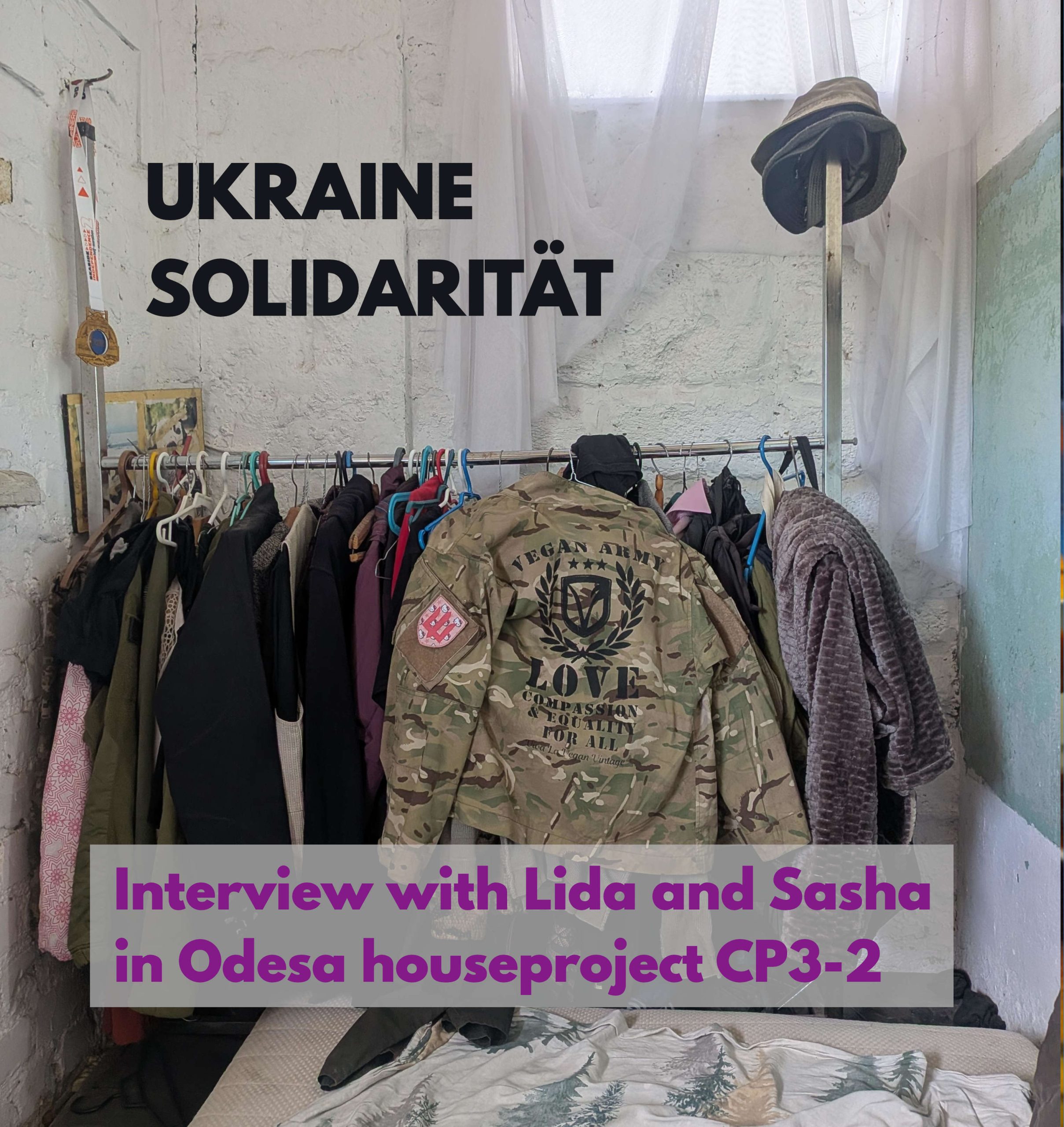
In Odesa, we visit the “CP3-2” housing project. The old ship repair factory is located in the heart of Odesa at the Black Sea. The industrial port and huge hotels are all within a hand reach. The building itself is dilapidated in many places and damp from rainwater. Before our trip, we raised money and purchased roofing felt to repair the roof. The project has been self-organized for many years, and the residents design and manage the space autonomously. There are private bedrooms, a shared bathroom, common areas, workshops, and an outdoor kitchen in the summer. About nine vegan activists live here permanently.
In this interview, we speak with two people from CP3-2 about their life in the house and what the place means to them. They talk about their activism, their experiences with each other, since the beginning and during the war, and how they cope with it.
Interview with Lida and Sasha in Odesa
Question: Could you please introduce yourselves?
Lida: My name is Lida. I’m a vegan, an activist, and right now I’m mainly focused on providing support to people fighting on the front line. I used to be involved in various vegan collectives. But since the war (full scale invasion) broke out, I’ve dedicated myself to this kind of support work. This is also because many people from my group have gone to the front lines or have participated in the armed struggle in other ways.
Sasha: My name is Sasha. I’m also a vegan and an anarchist. I’ve been vegan for eight years. I’m active in the group Eko-Plattforma, and in 2022 I participated in the armed struggle. I’m no longer in the army; I left a few months ago. Overall, I’m involved in vegan or pro-vegan activism, anti-authoritarian activism, and supporting various people and communities. I’ve been living in this house since 2024.
Question: What does this place, the CP3-2 housing project, mean to you?
Lida: When I moved in here six years ago, it was simply a place where you could lead an alternative lifestyle affordably and lead a collective way of living. That’s still true, but over time, its significance has changed. On the one hand, our comrades who have been fighting on the front lines can come here for a sort of recovery, just to settle back in and get back on their feet. On the other hand, it’s also a place in the city that provides infrastructure for various groups. Third, it’s a place where our comrades, who are going through a lot right now and are often very tired, can come to recover and rest. In Odesa, all the beaches are commercialized. Here, though, you can be by the sea without having to pay anything. Which isn’t usually the case. People from abroad come here, too.
Over time, SRZ-2 has become increasingly politicized. At the beginning, there were mostly artists, architects, and so on here. These people are still here, but over time they’ve become politicized along with us. They take part in actions and don’t just focus on art, they view things more politically and are more politically active.
I want to add one more thing, because I really love this place. We’ve also learned a great deal here. We have metal and woodworking workshops here. When we first arrived, there was simply nothing here. We built everything ourselves, and I learned a lot in the process: how to repair and renovate things. For example, this wall right here, next to which we’re sitting—I built it myself and learned how to do it along the way. We also installed all the toilets and the shower. This is a kind of school of life, so to speak, we learn so many skills here and teach each other.
Plus, we can have discussions here in a kind of activist safe space. We can organize events and exchange ideas on various topics.It really is a kind of safe space for activists.
Sasha: For me, this place is first and foremost my home, where I can live with friends and comrades. It’s a place where I don’t have to feel so isolated, as is often the case in big cities, where people just don’t get together that often. We can be together here and live together. And it’s also a place to learn how autonomy works, and where we try to put it into practice. In the sense that we acquire skills and knowledge, for example, regarding the things Lida has already mentioned. But it’s also a meeting place for different people who come together here.
Lida: I’d like to add that even though this place might seem drafty (with the wind blowing everywhere) or, for example, not so easy to heat, it was actually easier for us in winter, when there were those weeks with long blackouts without heat or electricity, than it was for people who just live in small apartments. We were already used to, for example, fetching water from the well or having to stoke the stove. We simply already had experience with that. We didn’t really have to change much at all. We know where the wells are; we had generators, and everyone knew, “Okay, I’ll do this, you do that,” so we could live well here. In some ways, it was actually harder for people, for example, for my comrades in Kyiv, who live in small apartments. We simply already had experience surviving without help from anyone.
Question: We’ve been here for two days now, and I’ve been observing how you interact with one another. I’ve seen a lot of tenderness and care between you. That really moved me. I’ve been wondering how you, as a community, are dealing with this tense situation—including grief and loss.
Lida: I’d definitely say that we’ve already developed certain care practices together here. Since we’re together all the time and just keep running into each other, we look out for one another. We don’t have big plenary sessions or anything like that, but there are lots of small groups or people who are close to one another and keep an eye on how everyone is doing. If something happens, for example, if someone has lost a loved one or something like that, we share that with the others and figure out how we can deal with it together. I’d say this is also a kind of survival strategy, much like stoking the stove: something we simply need and have developed over time. Simply because we’ve been living here together for so long. So far, we haven’t had any fights or anything like that, nor has anything really bad happened. No conflict has escalated into something truly serious, we’ve always found other solutions. Even when there were conflicts, we managed to defuse them.
We’re really not a homogeneous group. Very different people from different backgrounds live here, and we’ve come together around the idea that having a home or an apartment is a human right. That’s why most of the people who live here are involved in supporting the homeless. It’s a kind of shared consensus. Another shared consensus is that we’re all vegan here. But it’s also true that some people moved in, who weren’t vegan before, and then became vegan here, or people, who weren’t very political, and then became more politically active here. Beyond that, though, we also have very different perspectives and approaches.
Sasha: Exactly, it’s precisely this shared way of living together and simply being together. People who, as I said, used to just focus on art or whatever else they have become politically active and changed here. There’s simply a shared horizon of experience that emerges here and brings us together. It’s a shared experience that we build together. And it’s kind of like a seed, a seed for anti-authoritarian thinking or anti-authoritarian living.
This becomes clear, for example, in what we do when someone dies: we hold communal memorial evenings. We don’t just do this for people, who are currently fighting in the war; for instance, there was a security guard here who was tasked with watching over the grounds, and we had a lot of conflicts with him, but he was still somehow a part of this space. When he died, we held a memorial evening for him as well. When people decide to leave the house or, for example, the country, we try to give them a proper send-off and make sure they have a nice farewell.
Lida: Actually, this is really something that goes without saying, but I want to say it again anyway, and our experience shows this too: Collectively, it’s much easier to somehow get past the pain and work through it. Collectively, it’s easier to survive. Not just to survive the pain, but also, for example, all these capitalist impositions. It’s much easier when you’re not alone.
Sasha: It’s also true that here we don’t just treat people this way, we treat animals this way, too. We even have a small cemetery for animals that have died here. A cat, a seagull, a pigeon, and a raven are buried there. And the fact is, people feel pain when they die, too. We believe that animals are sentient beings with their own personalities, and we should have good relationships with them, and we shouldn’t eat them but should bury them instead.
Lida: Yes, and animals live with us, too. The little cat you saw was rescued by a comrade from Kherson, and she has her own little space here and can roam wherever she wants. She lives a bit wild in a way, but she always comes back. And then there’s the little free spirit, Bambi, the dog, who’s chilling out here with us right now.
Well, and the ones who also live here, and are actually the first occupants of this house, are the pigeons. They’re definitely part of it, too. Well, they were here first, so they definitely have a right to stay, even if they can be a real nuisance sometimes.
Question: I’d like to ask you a slightly more personal question, Sasha. It’s about your experiences, since you’ve already been to war. Maybe you can tell us how you made that decision, and perhaps also how you’re doing here now? How do you deal with your experiences?
Sasha: I went to fight in 2022. I was 20 years old at the time. It was a personal decision, a personal desire. I saw the need for it. I already felt that I actually wanted to confront this threat, which was looming over my home and my friends, as directly as possible. I wanted to stop it and protect my friends from what was happening, from this fascist and imperialist threat that had descended upon us. Because we’d already seen in the years before how things had changed in Russia and what had happened to the anarchists there. And we said to ourselves, “We have the means here to fight politically and stand up for our own rights.” But if we don’t fight back, that will definitely no longer be the case afterwards. In any case, it was a personal decision.
That’s just how it happened. I was drafted into the war and took an active part in it. It was very hard. It was constantly very hard, but I definitely had the motivation. I sustained injuries, and even aside from that, I went through some really difficult situations. But what was particularly hard were the structures within the army. As an anarchist, that extreme hierarchy that prevails there was a real problem for me. In that regard, it was definitely good to have horizontal structures, so to say, horizontal relationships with one another. That was also crucial for resisting the army and its structures.
There are opportunities here: anarchist units, or units influenced by anarchist ideals. These are military units, where many comrades are fighting. Above all, it’s important that the commanders also have the right mindset, share the same ideals, or at least support them. Because when you can make decisions together in a horizontal way and organize yourselves somewhat horizontally, it helps immensely.
Of course, what also contributed to my motivation was the realization I had, that if we don’t fight back here and now, and end up being occupied, things will definitely go badly for us. It’s possible that we’ll then be mobilized into the Russian army, where such opportunities simply don’t exist. I do think that if we simply give up without a fight now, Russia, since it is, after all, an imperialist aggressor state, would just keep going. And that is exactly what must be avoided at all costs.
Another thing that’s important for me to mention: I’ve remained vegan throughout all this time. I also wanted to use my own example to show that it’s possible to remain vegan even under the most difficult conditions. That was simply important to me because it’s often questioned. For example, I was in a trench near a settlement close to Bakhmut and, unfortunately, had to leave behind a vegan sausage that had come from Germany because we had to retreat. That was a real shame, but it happened. But that’s, so to speak, the physical proof that I remained vegan. It was important for me to show that it’s possible. It’s important not to forget the animals even during the war, because they suffer just as much from this war. And not to simply throw your own convictions and approaches overboard.
When I got injured, I couldn’t be on the front lines anymore. They said, “Okay, you can’t fight on the front lines anymore. That’s not possible.” And that’s why I was in the rear guard starting in mid-2024. So, I wasn’t on the front lines anymore, but I was still in the army, even though I wasn’t directly fighting. I used to live in Lviv and didn’t meet the people here until 2024, because I was transferred to Odesa. It actually happened at a memorial event on April 19, a memorial for Dmitri Petrov, Cooper Andrews, and Finbar Cafferkey. I went to the ceremony and met the people from here, and we really became friends. My friends then helped me when I returned. I managed to stay true to myself, my personality and my beliefs, despite these difficult circumstances. That’s also thanks to the people I met here and to this place.
Lida: Well, the example from Sasha actually illustrates our situation quite well. We were both part of different groups here and in Lviv that were both involved in vegan activism, and it’s a small scene. That’s why, as organizations, we knew of each other but didn’t really know one another personally. There was also no collaboration between the individual groups. And it wasn’t until we organized these public actions and events that we really got to know each other. A lot of people also came here from different cities: from Lviv, Kyiv, Kharkiv, and so on. So, while this war does allow you to meet new people, at the same time, it means you don’t see many people for an extremely long time, sometimes for years. And it’s unclear whether they’ll ever come back at all.
I want to make this clear once again, because it doesn’t seem to be entirely clear to some people in Western Europe. We have remained feminists, we have remained vegans, we have remained activists. Even as we take part in the struggle, even though we’ve decided here to take up arms, simply because this is our home. We want to stay here, we want to keep what we’ve built here. And we actually think it’s a pretty understandable reaction, when someone comes at you with a weapon, intent on killing you and turning your life completely upside down, to take up arms, defend yourself against it, and try to prevent exactly that from happening.
It’s really true: we need your solidarity, and we’ll continue to need it. Without the solidarity that has existed and continues to exist, and I know there has been a lot of solidarity, including from Dresden, among other places,we simply wouldn’t have been able to pull this off with Solidarity Collectives. We need a lot of help with this. Everything we’ve talked about is interconnected, because Solidarity Collectives has also helped Sasha, among others, and sent vegan food to the front lines. We need that solidarity, it’s important. Please, keep it up. And to everyone else reading this now: please, do the same.
For example, Solidarity Collectives also bought one of these plates for Sasha’s protective vest. And that vest actually provided protection. A large shard ended up lodged in it. It’s really true that things like this help save the lives of our comrades. Thank you all.
Thank you for the conversation.
We will start our next trip in October 2026.
We will stop by Odesa again, but we will also travel to Kharkiv to provide humanitarian aid.
Please support our fundraising campaign.